

It's a journalist's job to be a witness to history. We're not there to worry about ourselves. We're there to try and get as near as we can, in an imperfect world, to the truth and get the truth out.
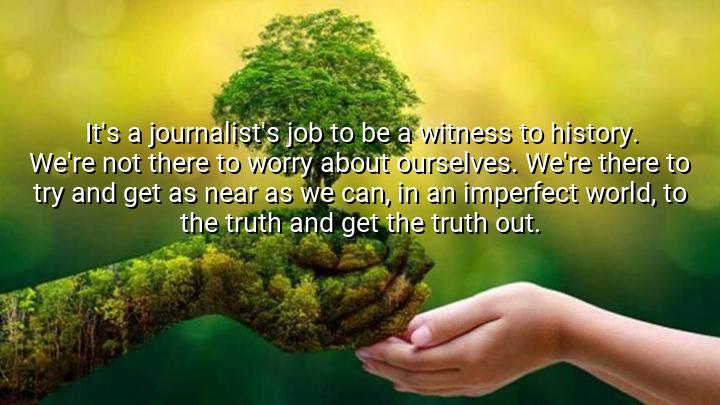




The quote "It's a journalist's job to be a witness to history. We're not there to worry about ourselves. We're there to try and get as near as we can, in an imperfect world, to the truth and get the truth out," by Robert Fisk, emphasizes the critical role of journalists in documenting and conveying the events of the world. Fisk highlights that a journalist's primary responsibility is not to seek personal gain or fame, but to observe and report the unfolding moments of history with integrity and accuracy. The quote underscores the importance of striving to uncover the truth, even when the circumstances are complex or difficult.
Fisk, a veteran war correspondent, was deeply committed to uncovering the truth of conflicts and their human cost. The origin of this quote can be linked to his decades of reporting from places such as Lebanon, Syria, and Afghanistan, where he often risked his life to bring untold stories to the public. Fisk believed that journalists were tasked with offering an honest account of events, especially in war zones, where the truth can be obscured by propaganda, bias, or fear. His statement emphasizes that while journalists may not always be able to deliver perfect or comprehensive truth, their duty is to get as close as possible to it.
The quote also reflects Fisk’s view that journalists must place the story above their own concerns or personal safety. In the face of danger, a journalist's commitment to documenting history and exposing the truth must take precedence over self-interest. Fisk saw his work not as a career but as a vital service to humanity, one that required dedication to revealing the realities of the world, especially when others might choose to ignore or obscure those truths.
Ultimately, Fisk’s quote serves as a reminder of the responsibility journalists have in shaping public understanding and historical record. By seeking the truth, even in an imperfect world, journalists act as the guardians of history, holding power to account and providing a clearer picture of the events that shape our lives. His words call on journalists to act with courage, humility, and dedication to their role as chroniclers of the human experience.

AAdministratorAdministrator
Welcome, honored guests. Please leave a comment, we will respond soon