

It was the experience of mystery - even if mixed with fear - that engendered religion.
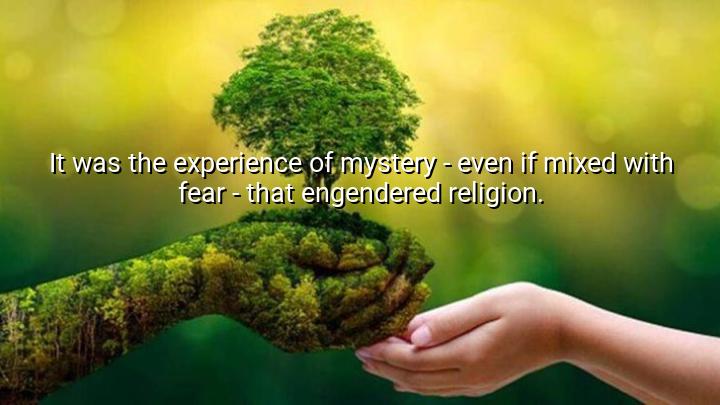




The quote by Albert Einstein explores the idea that mystery, even when accompanied by fear, is a fundamental force behind the development of religion. Einstein suggests that the awe and wonder provoked by the unknown, particularly in the face of life’s great mysteries—such as the origins of the universe or the meaning of existence—have driven humans to create systems of belief. Rather than seeing religion solely as a response to societal needs or moral questions, he links it to the deep, existential curiosity about the world that provokes both fear and fascination.
Einstein’s statement also suggests that the mystery of existence—our inability to fully comprehend the vastness and complexity of life—can be a source of both inspiration and intimidation. This paradoxical mix of emotions has often led people to seek answers through religion, which offers comfort and explanations in the face of uncertainty. Fear, in this context, does not necessarily imply negativity but rather an emotional response to the unknown, prompting humans to look for meaning beyond the material world.
The quote reflects Einstein’s personal view on religion and spirituality, which was deeply influenced by his fascination with the cosmos and the mysteries of nature. While he was not religious in the conventional sense, Einstein often spoke about a spiritual sense of awe towards the universe and the laws that govern it. This perspective reflects his belief that the mystery of life and the universe is what leads to a sense of wonder and reverence, often manifesting in religious or spiritual beliefs.
Originating from Albert Einstein, one of the most renowned physicists in history, the quote aligns with his broader philosophical views on science and religion. Although he was not aligned with any specific religious tradition, Einstein often discussed the relationship between science, mystery, and spirituality. He believed that the pursuit of knowledge and understanding should be accompanied by a sense of humility and awe before the vastness of the unknown. This quote serves as a reflection of his view that human curiosity, when faced with the mysteries of life, naturally leads to the creation of religious or spiritual frameworks.

AAdministratorAdministrator
Welcome, honored guests. Please leave a comment, we will respond soon