

It was once religion which told us that we are all sinners because of original sin. It is now the ecology of our planet which pronounces us all to be sinners because of the excessive exploits of human inventiveness.
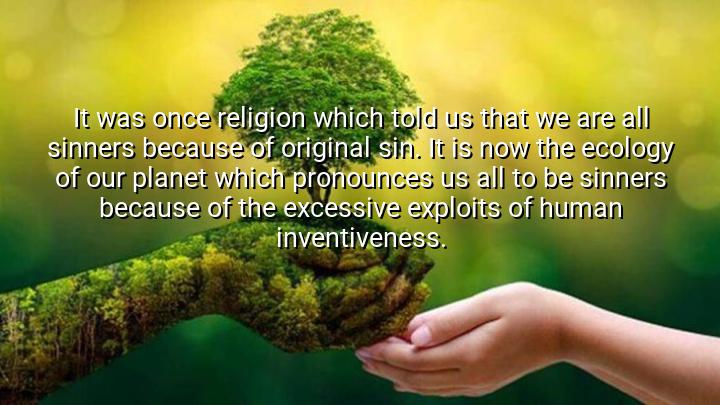




Hans Jonas’ quote draws a parallel between the concept of original sin in religion and the modern view of human actions through the lens of ecology. He points out that, historically, religion told us that humanity was inherently sinful due to original sin, a belief rooted in Christian theology. According to this view, all humans were born tainted by sin, and redemption was necessary for spiritual salvation. However, Jonas argues that in the contemporary world, it is no longer just religion that labels us as "sinners"; instead, ecology has taken on that role, condemning human actions as sinful because of the environmental damage caused by our innovations and exploitation of the planet.
In the modern context, Jonas refers to the idea that human inventiveness—the advancements in technology, industry, and civilization—has led to environmental degradation, such as pollution, deforestation, and climate change. This shift in perspective suggests that, instead of focusing on spiritual redemption, we must now seek moral responsibility in our treatment of the earth. The ecological crisis is framed as a form of sin, not in the theological sense, but in the way humanity’s unchecked progress has harmed the planet.
Jonas’ quote also reflects a deeper philosophical argument about the ethical implications of human progress. Where religion once held moral authority by defining the nature of human beings in terms of sin, ecology now functions as the moral judge of human actions, holding us accountable for the consequences of our technological and industrial pursuits. This shift implies a new ethical framework where humanity is called to reflect on its relationship with the environment and to take responsibility for the long-term sustainability of the earth.
Ultimately, Jonas’ words are a call for a reassessment of human values and the way we view our place in the world. He urges us to recognize that humanity’s progress has brought us to a point where our actions are not only morally questionable but also have profound consequences for the planetary ecosystem. This ecological "sin" invites a new moral responsibility for environmental stewardship, challenging us to balance innovation with the well-being of the earth.

AAdministratorAdministrator
Welcome, honored guests. Please leave a comment, we will respond soon