

It is undeniable that the looming environmental crisis is partly the consequence of population growth.
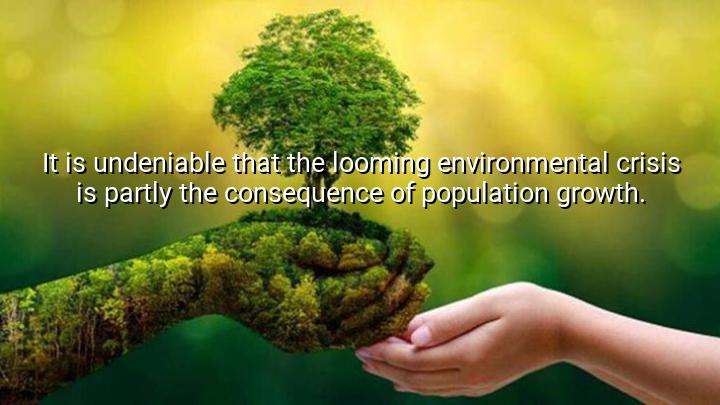




In this quote, Abhijit Banerjee, an economist and Nobel laureate, addresses the link between population growth and the environmental crisis. He suggests that one of the key contributors to the looming environmental crisis—such as climate change, resource depletion, and pollution—is the growth of the global population. As the world’s population continues to increase, the demand for resources, energy, and land also rises, putting significant pressure on the planet's ecosystems. Banerjee's statement highlights the unsustainable nature of exponential population growth in the context of environmental sustainability.
Banerjee is emphasizing that while factors such as industrialization, consumerism, and unsustainable agricultural practices also contribute to environmental degradation, population growth exacerbates these issues. More people means more consumption, more waste, and greater demand for energy, all of which strain the Earth's ability to absorb and process the resulting environmental impact. The quote suggests that without addressing the issue of population growth, efforts to mitigate the environmental crisis may fall short.
However, the quote also subtly implies that the environmental crisis cannot be solved by reducing population alone; it requires systemic changes in economic models, consumption patterns, and technological innovation. Banerjee, known for his work on poverty and development, likely points to the need for a holistic approach that includes both managing population growth and implementing sustainable practices at the individual, corporate, and government levels.
The origin of this quote lies in Banerjee’s broader focus on development economics and his exploration of the relationship between economic growth, social structures, and environmental sustainability. As a scholar, Banerjee has written extensively on the intersection of poverty, growth, and sustainability, and his work often addresses how complex factors such as inequality, population, and policy contribute to the world’s pressing global challenges. His recognition of the role of population growth in environmental degradation is part of his broader analysis of the forces shaping the modern world.

AAdministratorAdministrator
Welcome, honored guests. Please leave a comment, we will respond soon