

It is the nature of all greatness not to be exact.
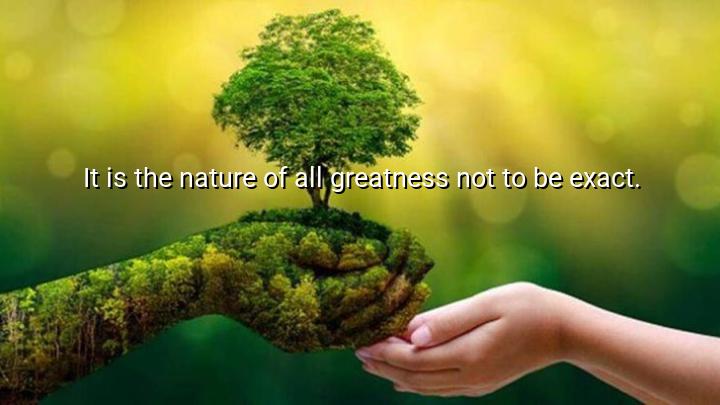




In this quote, Edmund Burke suggests that true greatness cannot be confined by rigid exactness or perfection. He argues that greatness, whether in character, achievement, or influence, is often defined by its flexibility, creativity, and boldness. The idea is that the most remarkable accomplishments or individuals are not restricted by the need to be exact or perfectly defined but are marked by their capacity to embrace ambiguity and vision beyond the ordinary.
Burke’s statement challenges the conventional view that precision and perfection are necessary for success. Instead, he emphasizes that greatness comes from the ability to adapt, take risks, and pursue ideas that may not always fit neatly into predefined molds. This perspective suggests that the most significant contributions to society often arise from individuals or movements that are innovative, unconventional, and willing to challenge the status quo.
The origin of this quote lies in Burke's philosophical and political writings, where he often discussed the nature of society, leadership, and change. He believed that true progress and reform could not always be achieved through exact formulas or rigid structures but instead required flexibility and the courage to embrace uncertainty. In this way, Burke saw greatness as something that often defied clear definitions and exact parameters.
Ultimately, Burke’s quote encourages us to reconsider the traditional view of success and greatness. It reminds us that the path to true achievement is not always linear or precise, and often it is the freedom to explore and innovate that leads to the most significant contributions. Greatness, in Burke's view, is as much about the journey and vision as it is about the final result.

AAdministratorAdministrator
Welcome, honored guests. Please leave a comment, we will respond soon