

It is not the greatness of a man's means that makes him independent, so much as the smallness of his wants.
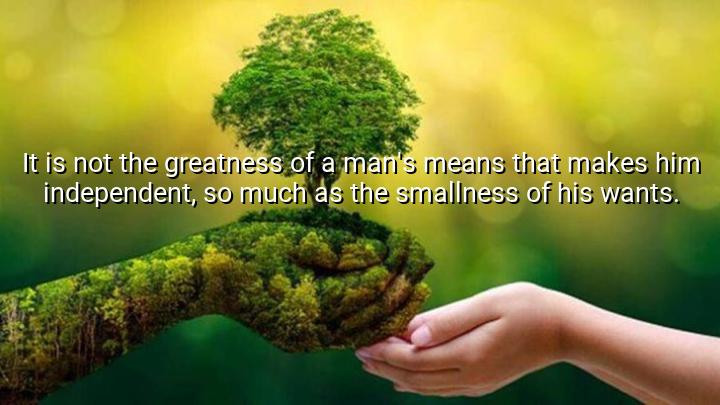




The quote "It is not the greatness of a man's means that makes him independent, so much as the smallness of his wants." by William Cobbett emphasizes the idea that true independence is not determined by how much wealth or material resources one has, but by how little one needs to live a fulfilling life. Cobbett suggests that self-sufficiency and freedom are more about having modest desires and being content with fewer things than about accumulating wealth. Independence, in this view, is about simplifying one’s life and not being dependent on excessive material possessions or external sources of support.
The origin of this quote comes from Cobbett’s writings as a political reformer and journalist in the early 19th century. Cobbett was a critic of the industrial revolution and the growing materialism of his time. He argued that true independence came from living simply, rather than chasing after the luxuries and excesses that often lead to financial or emotional dependence. This perspective was rooted in his belief in the importance of personal integrity and the dangers of becoming overly reliant on external wealth or societal structures.
Cobbett’s idea that the smallness of one’s wants is key to independence suggests a lifestyle focused on personal discipline and contentment rather than on external achievements or material success. By reducing one’s desires, a person can live with less stress and be less susceptible to the pressures that come with chasing after more. This self-restraint is not about deprivation but about valuing what truly matters, leading to a more peaceful and empowered life.
The quote challenges conventional views of wealth and success, proposing that the most independent people are those who are content with simplicity and do not rely on constant consumption. Cobbett’s words encourage individuals to find freedom not in accumulating resources but in controlling their desires and learning to thrive with less, thus achieving a more authentic and self-sufficient form of independence.

AAdministratorAdministrator
Welcome, honored guests. Please leave a comment, we will respond soon