

It is a thousand times better to have common sense without education than to have education without common sense.
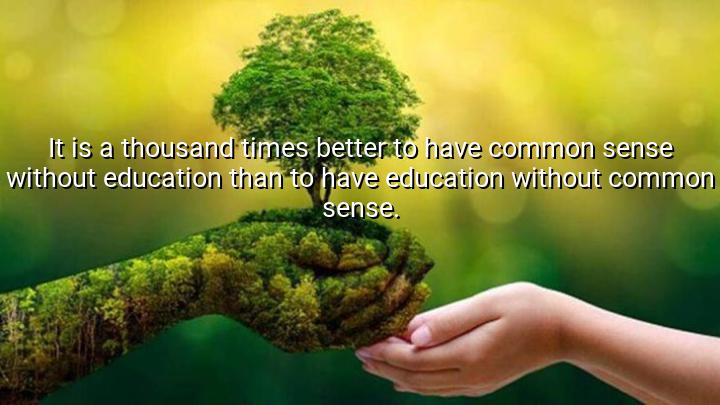




In the quote "It is a thousand times better to have common sense without education than to have education without common sense," Robert Green Ingersoll stresses the importance of practical wisdom over formal education. He argues that common sense—the ability to make sound judgments and decisions based on practical experience and understanding—outweighs academic knowledge that might be learned without a deep understanding of how to apply it in the real world. While education provides valuable information, it is common sense that allows individuals to navigate life effectively.
Ingersoll's quote suggests that education on its own, without the grounding of common sense, can lead to intellectualism that is disconnected from reality. Education may offer theoretical knowledge, but it can be ineffective if it does not enable someone to deal with everyday situations, solve practical problems, or understand human nature. In contrast, a person with common sense might not have formal education but is likely better at making informed decisions in daily life because they can apply their experiences and intuition.
The phrase "a thousand times better" emphasizes the immense value of common sense in comparison to academic knowledge. It’s a reminder that practical intelligence is more useful in many aspects of life than book knowledge, especially when it comes to interacting with people, making decisions, and facing the challenges of daily existence. Ingersoll highlights that wisdom in handling real-world situations is often more important than merely having a degree or educational credentials.
Ultimately, Ingersoll’s quote advocates for the idea that common sense is an essential life skill that often supersedes formal education. It encourages a balanced approach to learning, one that values practicality and intuitive decision-making alongside intellectual pursuits. The quote serves as a reminder that true intelligence comes from being able to apply knowledge wisely and effectively in the real world.

AAdministratorAdministrator
Welcome, honored guests. Please leave a comment, we will respond soon