

Isn't it amazing that we are all made in God's image, and yet there is so much diversity among his people?
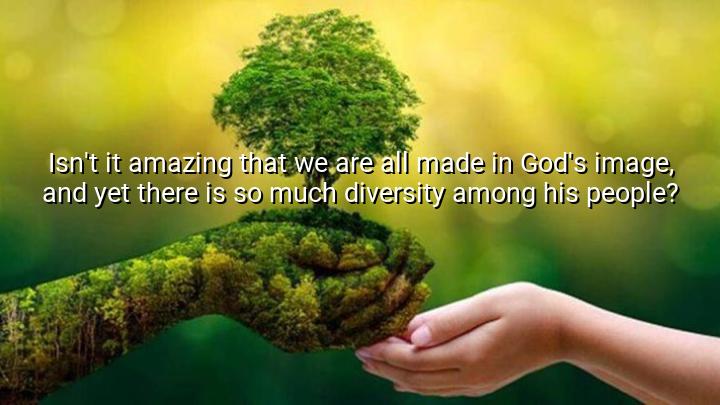




The quote by Desmond Tutu — "Isn't it amazing that we are all made in God's image, and yet there is so much diversity among his people?" — reflects on the paradox of human diversity in the context of shared divine creation. Tutu expresses awe at the fact that, despite all humans being created in God's image, each person is unique, with differences in culture, appearance, beliefs, and experiences. This diversity, according to Tutu, is part of the beauty and richness of humanity, demonstrating the complexity and depth of God's creation.
Tutu's statement invites us to reflect on the relationship between unity and diversity. While we share a common origin as creations of God, the differences among us are not contradictions but rather expressions of the vastness of God’s creativity. These differences should not divide us but rather enrich our understanding of one another, encouraging respect and celebration of diversity. In Tutu's view, diversity is a testament to the infinite possibilities inherent in God's image.
The origin of this quote is tied to Tutu’s work as an Archbishop and human rights activist in South Africa, where he spent much of his life advocating for reconciliation and unity in the face of profound social and racial divisions. As a leader in the fight against apartheid, Tutu sought to emphasize the common humanity shared by all people, regardless of background, and this quote underscores his belief that diversity is something to be embraced, not feared.
Ultimately, Tutu’s words remind us that diversity is a natural and beautiful part of the human experience, one that reflects the richness of **

DTChi Py De Thuong
I find this quote to be spiritually uplifting and socially relevant. It highlights a truth that seems obvious but is so often overlooked: that difference doesn’t contradict shared value. But how do we move from appreciating this idea in theory to applying it in real-life systems—like justice, education, and politics? Maybe the hardest part isn’t believing it, but living it out consistently when biases run deep.
NHNguyen Hoang
The quote raises a deep and beautiful paradox—how can we be the same yet so different? It actually reminds me of the idea that unity doesn’t require uniformity. But how can societies better reflect this philosophy in policy and education? If we taught children to see others as different expressions of the same human value, maybe we’d see less prejudice. I'd love to hear thoughts on how to bring this idea into action.
PNLan Phuong Nguyen
This quote feels both comforting and profound. But I wonder how it resonates with people who don't believe in God or who follow different spiritual paths. Can the message of valuing diversity still be universally meaningful, even if you interpret 'God’s image' more symbolically? I think this could open up interesting dialogue about shared human dignity and how spiritual metaphors can promote inclusion beyond religious boundaries.
CTCan Tran
Desmond Tutu’s words feel especially powerful in today's world, where so many divisions still exist based on race, religion, gender, and identity. If our differences are part of God’s image, does that mean intolerance is a rejection of the divine itself? That’s a challenging question. How do we encourage people to see diversity as a strength rather than a threat, especially within the contexts of faith and tradition?
APANH PHONG
I love how this quote reframes diversity as something sacred. It makes me ask: if diversity is inherent in our shared divine image, why is it so often feared or resisted, especially in faith communities? Shouldn’t religious teachings lead to celebration of differences, rather than attempts to erase or standardize them? I think this idea could really shift how we talk about inclusion and equality on a spiritual level.