

Instruction ends in the schoolroom, but education ends only with life. A child is given to the universe to be educated.
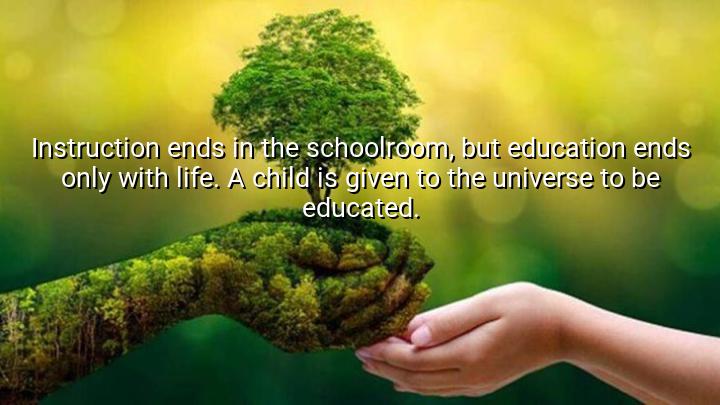




The quote by Frederick William Robertson emphasizes the distinction between instruction and education. Robertson suggests that while formal instruction is limited to the schoolroom, true education is a lifelong process that extends far beyond the confines of structured learning. This perspective highlights that learning is not just about memorizing facts or completing curricula, but about ongoing personal growth, exploration, and understanding throughout one’s life.
By stating that a child is "given to the universe to be educated," Robertson underscores the idea that education is influenced by the broader world—through experiences, relationships, and exposure to diverse ideas. The quote emphasizes that every interaction and observation contributes to a child’s development, reinforcing that education is a holistic process shaped by society, culture, and the environment, not just by teachers or classrooms.
The origin of this quote is from Frederick William Robertson (1816–1853), an English preacher and theologian known for his eloquent reflections on human life, morality, and spiritual development. Robertson often spoke on the importance of cultivating the whole person, not just imparting formal knowledge. His writings advocate for an education that nurtures character, understanding, and moral insight, in addition to intellectual growth.
Ultimately, this quote reminds readers that education is a lifelong journey, not confined to formal instruction. It encourages a broader understanding of learning, emphasizing that a child’s growth and development are shaped by both structured teaching and the vast array of experiences offered by the universe. True education, therefore, continues until the end of life, encompassing knowledge, character, and wisdom.

AAdministratorAdministrator
Welcome, honored guests. Please leave a comment, we will respond soon