

In true education, anything that comes to our hand is as good as a book: the prank of a page- boy, the blunder of a servant, a bit of table talk - they are all part of the curriculum.
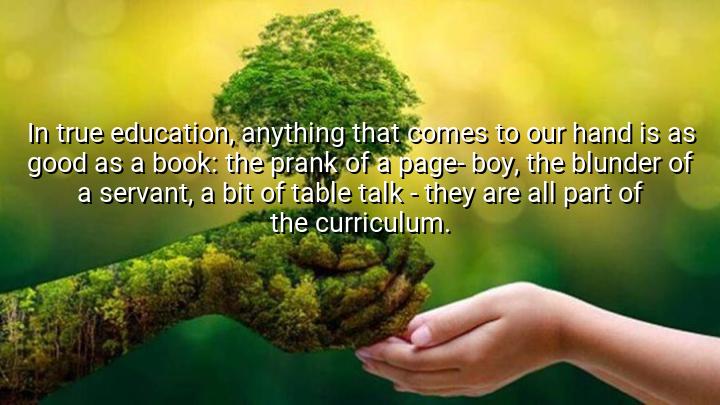




The quote “In true education, anything that comes to our hand is as good as a book: the prank of a page-boy, the blunder of a servant, a bit of table talk – they are all part of the curriculum.” by Michel de Montaigne reflects his belief that education is not confined to books or formal instruction. Instead, true education is drawn from everyday experience, where even the smallest incidents—such as a prank, a blunder, or casual conversation—can become valuable lessons. For Montaigne, life itself is a curriculum that teaches us how to think, observe, and understand.
By suggesting that a servant’s mistake or a child’s mischief can be as instructive as formal study, Montaigne emphasizes the importance of practical wisdom. He believed that learners should be open to insights from all situations, cultivating curiosity and the ability to draw meaning from ordinary events. This approach rejects rigid systems of education that focus only on memorization, instead advocating for the development of judgment and critical thinking through lived experience.
The origin of this perspective lies in Montaigne’s Essays, written in the 16th century, where he explored themes of human nature, learning, and philosophy. As one of the earliest modern thinkers to question traditional methods of schooling, Montaigne argued that education should shape the whole person, not just fill the mind with facts. His reflections were deeply influenced by Renaissance humanism, which valued both intellectual and experiential knowledge.
In essence, Montaigne’s quote reminds us that education is everywhere—it is found in books, yes, but equally in life’s interactions and mistakes. To him, the role of education was to teach adaptability, discernment, and self-knowledge, all of which arise not only from formal lessons but from the texture of everyday living.

AAdministratorAdministrator
Welcome, honored guests. Please leave a comment, we will respond soon