

In the history of science, we often find that the study of some natural phenomenon has been the starting point in the development of a new branch of knowledge.
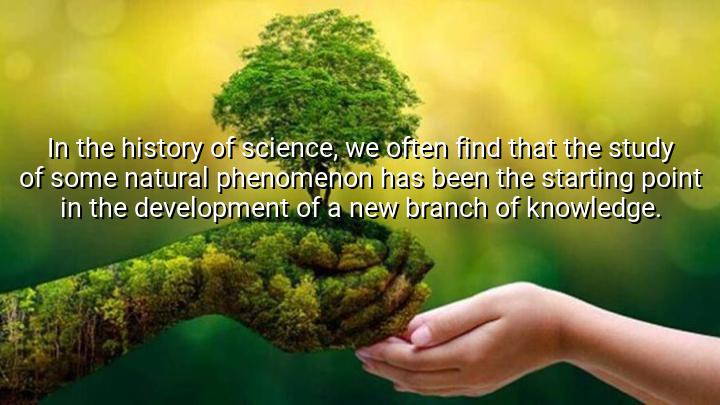




In this quote, C. V. Raman, a renowned physicist, highlights how the study of natural phenomena has often been the catalyst for the development of new branches of knowledge in the field of science. Raman is emphasizing that many scientific discoveries and advancements originate from observing and experimenting with the world around us. The quote suggests that curiosity about the natural world can lead to groundbreaking insights that ultimately contribute to the evolution of entire scientific disciplines.
Raman’s statement points to the interconnectedness of different areas of science. For example, his own work in optics—particularly the discovery of the Raman Effect, which explains how light interacts with matter—was rooted in the study of light and its properties. This discovery not only contributed to the field of physics but also paved the way for new areas of study, such as molecular spectroscopy and quantum mechanics, demonstrating how one natural phenomenon can open doors to entirely new realms of scientific inquiry.
The quote also reflects the dynamic nature of scientific progress. It suggests that scientific knowledge does not grow in a linear fashion but instead expands through a process of discovery and exploration. As researchers investigate the unknown or try to explain complex phenomena, they often stumble upon new questions or ideas that lead to the creation of new scientific fields or sub-disciplines. This process of continual expansion is central to the development of human understanding in science.
The origin of this quote comes from C. V. Raman, who was deeply invested in the idea of scientific curiosity and discovery. Raman’s contributions to physics, particularly his work on light scattering, earned him the Nobel Prize in Physics in 1930. His quote reflects his view of science as an ever-evolving field that is constantly enriched by the study of the natural world, with each discovery potentially leading to a new frontier of knowledge.

AAdministratorAdministrator
Welcome, honored guests. Please leave a comment, we will respond soon