

In school you teach us not to fight with others, to work things out, to respect others, to clean up our mess, not to hurt other creatures, to share, not be greedy. Then why do you go out and do the things you tell us not to do? You grownups say you love us, but I challenge you, please, to make your actions reflect your words.
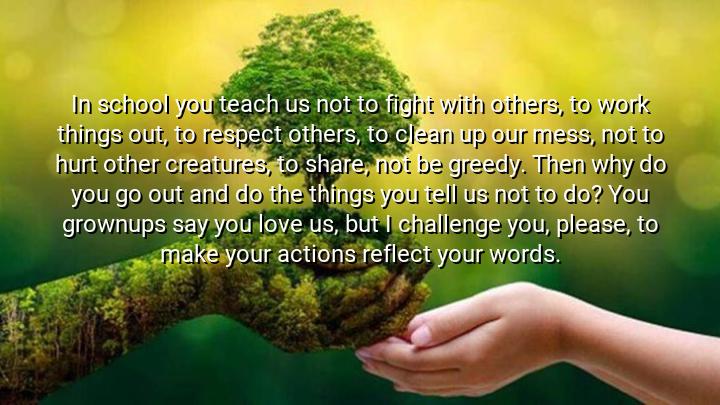




Severn Cullis-Suzuki’s quote, “In school you teach us not to fight with others, to work things out, to respect others, to clean up our mess, not to hurt other creatures, to share, not be greedy. Then why do you go out and do the things you tell us not to do? You grownups say you love us, but I challenge you, please, to make your actions reflect your words,” is a powerful critique of the inconsistency between the values taught to children and the behaviors exhibited by adults, especially in regard to environmental issues. Cullis-Suzuki is calling attention to the hypocrisy she perceives in adults, who preach moral values to the younger generation but fail to live up to them in their actions. She challenges adults to align their behavior with the values they try to instill in children, particularly concerning the environment and the treatment of the planet.
The message of this quote highlights a disconnect between what is taught to children in schools—such as respect, cooperation, and responsibility—and the actions of adults, particularly in areas like environmental conservation. Cullis-Suzuki points out that adults are guilty of actions that harm the planet, such as pollution, deforestation, and overconsumption, which directly contradict the lessons they teach children about respecting nature and sharing resources. Her words serve as a call to action for adults to reassess their behavior and take responsibility for the future they are shaping for the next generation.
Severn Cullis-Suzuki was a young environmental activist when she delivered this speech at the United Nations Earth Summit in 1992, which was attended by world leaders from various countries. Her poignant message resonated globally, highlighting the urgency of addressing environmental issues and questioning the integrity of adult leadership. The quote reflects her commitment to the environmental movement and her desire to see meaningful change in how adults approach the protection of the Earth.
In a broader context, Cullis-Suzuki’s words resonate with ongoing conversations about intergenerational responsibility and sustainability. The quote serves as a reminder that children are often the first to see the contradictions in adult behavior and that true leadership requires more than just words—it demands action. Her call for adults to reflect on their values and live according to the lessons they teach has become an enduring message in environmental advocacy, urging society to protect the planet not just for the present, but for future generations.

AAdministratorAdministrator
Welcome, honored guests. Please leave a comment, we will respond soon