

In its Declaration of Independence on May 15, 1948, Israel stretched out its hand in peace to its Arab neighbors, calling for an end to war and bloodshed. In response, seven Arab states invaded Israel. The U.N. resolution that partitioned the country was thus violated and effectively annulled.
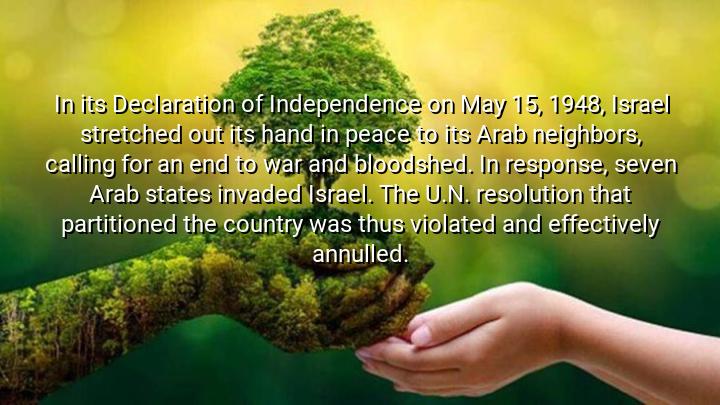




In this quote, Yitzhak Shamir, the former Prime Minister of Israel, reflects on the events surrounding the Declaration of Independence of Israel on May 15, 1948. Shamir highlights the key message in Israel's declaration, which extended a hand in peace to its Arab neighbors, urging them to end the ongoing conflict and bloodshed. This emphasizes Israel's desire for peace and coexistence with its neighbors at the moment of its establishment as an independent nation.
However, Shamir points out that instead of responding to Israel's plea for peace, seven Arab states launched an invasion against the newly declared state. This military response undermined the intention behind the declaration and escalated the conflict. Shamir's statement underscores the dramatic contrast between Israel’s offer of peace and the subsequent aggressive actions taken by its neighbors, illustrating the challenges the country faced in securing peace from the outset.
The quote also refers to the U.N. resolution that partitioned the land, which was intended to create separate Jewish and Arab states in the region. By invading, Shamir argues that the Arab states effectively violated and annulled the U.N. plan, which had been endorsed as a means of establishing a peaceful resolution. This reflects Shamir’s view that the actions of the Arab states not only disregarded Israel’s right to exist but also disrupted the international efforts to create a peaceful solution in the region.
Ultimately, Shamir’s quote frames the founding of Israel as an attempt at peace that was met with violence and hostility. He emphasizes the contradiction between Israel's peaceful intentions and the subsequent invasion, highlighting how the early years of the Israeli state were marked by conflict, despite its call for peace. This history forms part of the broader narrative of the ongoing struggle for peace and recognition in the region.

AAdministratorAdministrator
Welcome, honored guests. Please leave a comment, we will respond soon