

In history as in human life, regret does not bring back a lost moment and a thousand years will not recover something lost in a single hour.
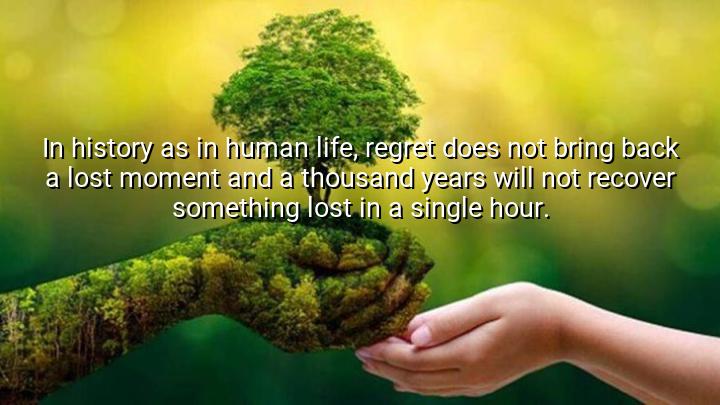




Stefan Zweig’s quote emphasizes the irreversible nature of time in both history and human life. By stating that “regret does not bring back a lost moment,” he highlights the futility of dwelling on the past once opportunities or events have slipped away. His words point to the harsh truth that no matter how much one reflects or mourns, what is lost—whether in a personal life or in the fate of nations—cannot be recovered.
The meaning of this statement lies in its cautionary wisdom. Zweig reminds us that both individuals and societies must act with awareness and responsibility in the present, because decisions carry irreversible consequences. The line “a thousand years will not recover something lost in a single hour” illustrates how quickly opportunities, freedoms, or lives can vanish, and how permanent those losses can be. It is a meditation on fragility, urging readers to cherish and act wisely in every moment.
The origin of this quote can be traced to Zweig’s reflections as an Austrian writer and thinker during the early 20th century. Living through the collapse of the Austro-Hungarian Empire, the devastation of World War I, and later witnessing the rise of fascism, Zweig saw firsthand how entire eras of culture and civilization could vanish almost overnight. His writings, such as The World of Yesterday, often dwell on nostalgia, impermanence, and the tragedies of history.
Ultimately, Zweig’s words serve as both a lament and a warning. They remind us that neither regret nor the passage of time can undo loss—whether personal or historical. His quote urges us to recognize the weight of each decision and moment, because once gone, even centuries cannot restore what has been lost. It is a timeless reflection on impermanence and responsibility.

AAdministratorAdministrator
Welcome, honored guests. Please leave a comment, we will respond soon