

In dream consciousness... we make things happen by wishing them, because we are not only the observer of what we experience but also the creator.
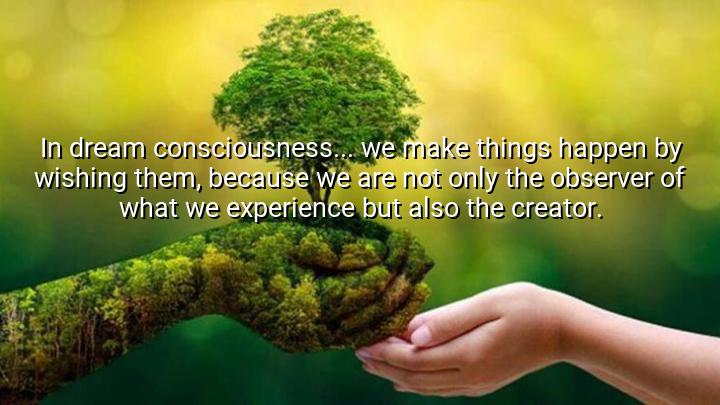




In the quote by Pir Vilayat Khan, "In dream consciousness... we make things happen by wishing them, because we are not only the observer of what we experience but also the creator," Khan explores the concept of the dream as a space where the mind is not passive, but actively shapes its own reality. He suggests that in the realm of dream consciousness, individuals have the power to create their experiences through intention and wishing. In this state, the boundaries between observer and creator blur, allowing the dreamer to influence and shape their own reality.
The origin of this quote comes from Khan's philosophical and spiritual teachings, where he often spoke about the nature of consciousness, perception, and spiritual insight. As a Sufi master, Khan believed that the mind had the potential to transcend ordinary perception, allowing individuals to access higher states of consciousness. The idea that we are not merely observers of our dreams but also creators is rooted in Sufi mysticism, which teaches that the individual soul plays an active role in shaping both its inner and outer worlds.
Khan's statement also touches on the power of the subconscious and the ability to influence it through conscious wishing or intention. In dream consciousness, we are not limited by physical reality, and our thoughts, desires, and emotions can manifest into experiences. This idea aligns with the belief that the mind and consciousness are far more powerful than they might seem at the surface level, especially in altered states like dreams.
Ultimately, Khan’s quote invites us to recognize the creative potential within ourselves, especially in realms like dreams, where the usual constraints of reality are lifted. It suggests that we are not passive recipients of our experiences but active participants who can shape our worlds through conscious intention, even within the dream state. This perspective encourages a deeper understanding of the mind's capabilities and its role in both spiritual and creative exploration.

AAdministratorAdministrator
Welcome, honored guests. Please leave a comment, we will respond soon