

Immortality is the negation of death. We do not usually speak about 'innatality' - about having not yet been born - yet this is something we would have to regard as the other aspect of the human soul. We are just as unborn as we are immortal.
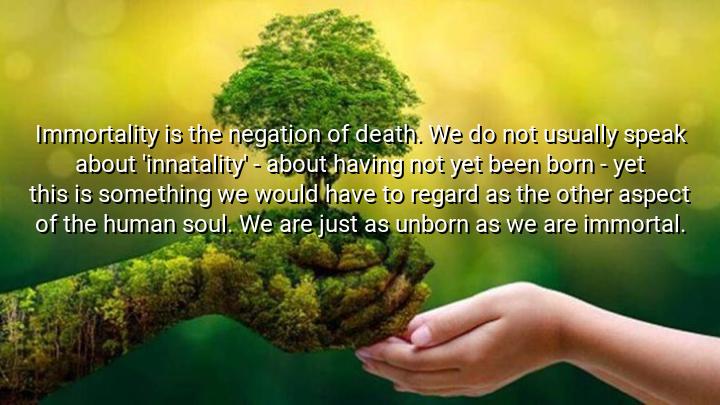




The quote "Immortality is the negation of death. We do not usually speak about 'innatality' - about having not yet been born - yet this is something we would have to regard as the other aspect of the human soul. We are just as unborn as we are immortal." by Rudolf Steiner explores the philosophical and spiritual concept of immortality and existence. Steiner suggests that immortality, which is typically understood as life beyond death, is essentially the negation or opposite of death. He invites us to consider not just life after death but also life before birth, referring to the soul as having an equally significant state of non-existence prior to birth.
Steiner further introduces the concept of "innatality", a term he uses to describe the state of having not yet been born. By focusing on the unborn state, he contrasts it with immortality, proposing that the human experience encompasses both the time before birth and the time after death. This perspective challenges conventional views of existence, suggesting that time and identity are not confined solely to the life we experience between birth and death but extend beyond that in both directions.
The origin of this quote comes from Rudolf Steiner's work in spiritual science and anthroposophy, which blends philosophy, spirituality, and science. Steiner often discussed themes related to the soul, reincarnation, and immortality, encouraging individuals to think beyond traditional concepts of life and death. He saw the soul as enduring, experiencing different stages before birth, during life, and after death. This quote is a reflection of his belief in the continuous existence of the soul, not limited by physical birth or death.
Ultimately, Steiner's quote invites us to rethink our understanding of existence, immortality, and death. By emphasizing the unborn state as just as significant as being immortal, he suggests that life is a much broader experience than we often consider, stretching across realms of time and spiritual existence that go beyond the physical world. The quote challenges us to reflect on the soul's eternal nature and the deeper mysteries of life and death.

AAdministratorAdministrator
Welcome, honored guests. Please leave a comment, we will respond soon