

I'm very concerned for the future of the earth and its amazing creatures. We've got to be careful and make sure we don't foul our own nest.
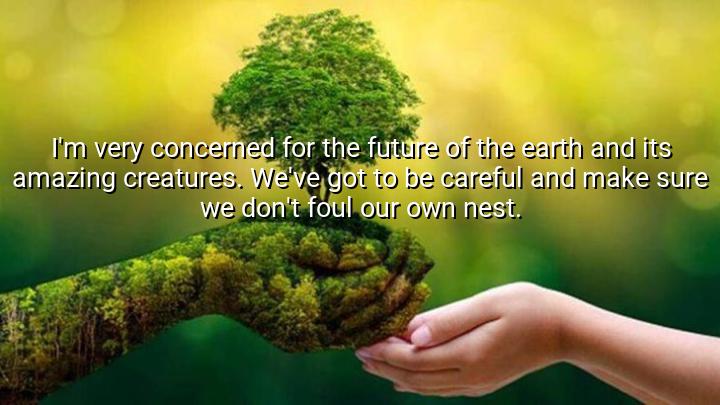




In the quote, "I'm very concerned for the future of the earth and its amazing creatures. We've got to be careful and make sure we don't foul our own nest," John Lithgow expresses his deep concern about the state of the planet and the well-being of its inhabitants. He emphasizes the urgency of protecting the earth and its creatures, acknowledging that our actions have a direct impact on the environment. Lithgow's words highlight the interconnectedness of human activity and ecological health, urging people to take responsibility for the damage we might cause.
The phrase "foul our own nest" is a metaphorical way of saying that we should not harm the very environment that sustains us. Lithgow is warning against actions that could destroy or pollute our surroundings, just as an animal wouldn't want to soil the place where it lives. By using this metaphor, Lithgow calls attention to the idea that we should care for our earth as we would care for our own home, stressing that neglecting the environment ultimately harms ourselves as well.
Lithgow’s quote is a reminder of the responsibility we have to preserve the earth for future generations. His concern for the amazing creatures that share the planet with us reflects a broader environmental awareness, acknowledging the diverse life forms that depend on a healthy ecosystem. By linking this concern to the need for careful, mindful actions, Lithgow advocates for a more sustainable and respectful relationship with nature.
The origin of this quote ties into John Lithgow's long-standing advocacy for environmental issues, using his platform to raise awareness about the importance of protecting nature. Through this statement, Lithgow not only highlights the beauty and fragility of life on Earth but also urges everyone to act before it is too late. His message resonates with the growing environmental movement, encouraging a collective effort to preserve the planet's resources and protect its amazing creatures.

MTMoc Tra
I wonder how Lithgow’s concerns translate into actionable steps for ordinary people. Beyond awareness, what practical measures can communities and individuals take to ensure they’re not harming the planet? Also, how can we hold corporations and governments accountable? It’s a complex issue, but this quote reminds me that protecting our home is a shared responsibility that requires cooperation on all levels.
MTDoan Minh Tri
This quote makes me reflect on the role of education and media in shaping attitudes toward environmental care. How effective are current efforts in educating younger generations about the importance of sustainability? Are there cultural or societal shifts happening that might help or hinder our ability to protect Earth and its creatures? It’s crucial to consider how to communicate these issues in a way that motivates lasting change.
CTPhan Tran Cam Tu
I appreciate Lithgow’s clear sense of urgency. But I’m curious—what do you think are the biggest obstacles to achieving real environmental protection? Is it lack of awareness, political will, economic pressures, or something else? Understanding these barriers might help in finding innovative solutions that can be implemented globally before it’s too late.
VHNguyen Viet Hoang
This quote sparks concern about the creatures Lithgow mentions. How much are endangered species and biodiversity being considered in environmental policies today? Does focusing on economic growth often come at their expense? I wonder if raising awareness through voices like Lithgow’s can shift public opinion to prioritize preserving ecosystems and the amazing wildlife that inhabit them.
LLNBN
The phrase ‘don’t foul our own nest’ is such a powerful metaphor. It makes me think about personal responsibility—how much does individual behavior really impact global environmental health? Are small actions like recycling or conserving energy enough, or do we need systemic change from governments and industries? I’d love to explore how to inspire both individual and collective accountability for our planet’s future.