

I'm not a religious person, and I'm not too interested in being a part of a religion, but I do like having some sort of communal gathering, and having some sense of peoples.
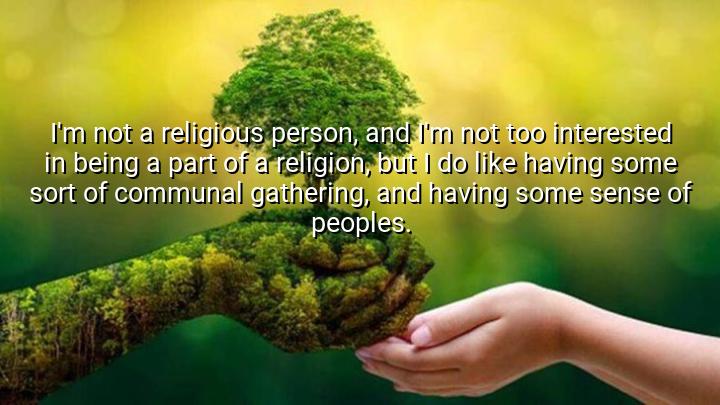




In this quote, Ian MacKaye, a musician known for his involvement in the punk and hardcore scenes, expresses a complex relationship with religion and community. He begins by clarifying that he is "not a religious person" and has little interest in the formal aspects of organized religion. However, he acknowledges the value of communal gathering, suggesting that while he doesn’t connect with traditional religious practices, he still values the sense of belonging and connection that comes from being part of a community. This speaks to the human need for shared experiences and collective identity, regardless of whether those experiences are tied to religion.
MacKaye’s emphasis on having "some sense of peoples" reflects his desire for solidarity and connection with others. While religion often serves as a means to create a sense of community, he sees that same need being met through other forms of gathering, such as the punk scene or any group that offers a sense of purpose and mutual support. This highlights the idea that people crave belonging, shared values, and companionship, which can be found outside of traditional religious structures.
His statement also underscores the differentiation between spirituality and religion. While he may not subscribe to religious dogma, MacKaye seems to recognize the spiritual importance of community and collective action. The sense of belonging and unity within a group can provide emotional and social support, which is often a central function of religion. In his case, it seems that the values of mutual respect, solidarity, and purpose found in alternative communities satisfy that need without the institutionalized structure of religion.
The origin of this quote reflects MacKaye’s broader philosophy about individuality, community, and the power of non-conformity. As a key figure in the punk rock scene, MacKaye has long advocated for independence from mainstream societal structures, including organized religion. His involvement in bands like Minor Threat and Fugazi was not just about music, but about creating spaces for like-minded people to gather, support one another, and challenge conventional systems. This quote highlights how MacKaye values the social aspect of religion—community and togetherness—without necessarily subscribing to its traditional forms.

AAdministratorAdministrator
Welcome, honored guests. Please leave a comment, we will respond soon