

I'm always pushing for human responsibility. Given that chimpanzees and many other animals are sentient and sapient, then we should treat them with respect.
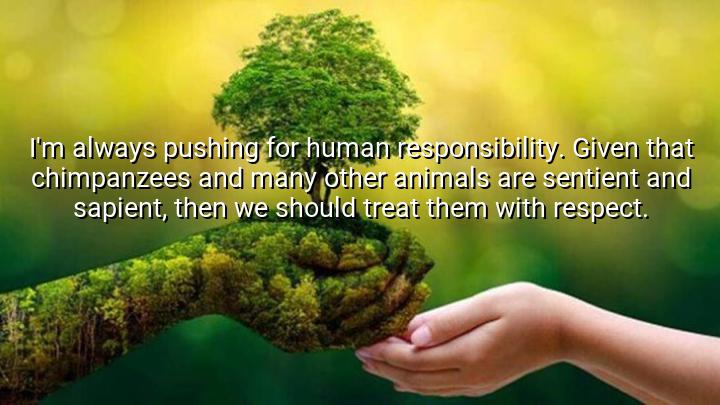




The quote by Jane Goodall emphasizes the importance of human responsibility in our interactions with other sentient and sapient animals. Goodall argues that because animals such as chimpanzees possess awareness, intelligence, and emotional depth, humans have an ethical duty to treat them with respect and consideration. Her words underscore a broader principle of moral responsibility toward all living beings capable of thought and feeling.
By highlighting the sentience and sapience of animals, Goodall draws attention to their capacity for emotion, problem-solving, and social interaction. This challenges the traditional view of humans as the sole possessors of complex consciousness and reinforces the idea that ethical treatment should extend beyond our own species. Her quote advocates for empathy and recognition of animal rights in both research and everyday life.
The origin of this quote comes from Goodall’s work as a primatologist and conservationist, particularly her decades-long research on chimpanzee behavior in Gombe Stream National Park. Her observations of primates’ social structures, intelligence, and emotions have informed her advocacy for animal welfare and environmental conservation, emphasizing that humans have a moral obligation to protect and respect other species.
Overall, the quote illustrates Goodall’s philosophy of ethical responsibility and respect toward animals. She encourages humans to recognize the intrinsic value of sentient life and to act with compassion and accountability, reinforcing the idea that our intelligence comes with the duty to ensure the well-being of other creatures.

AAdministratorAdministrator
Welcome, honored guests. Please leave a comment, we will respond soon