

I'm a latecomer to the environmental issue, which for years seemed to me like an excuse for more government regulation. But I can see that in rich societies, voters are paying less attention to economic issues and more to issues of the spirit, including the environment.
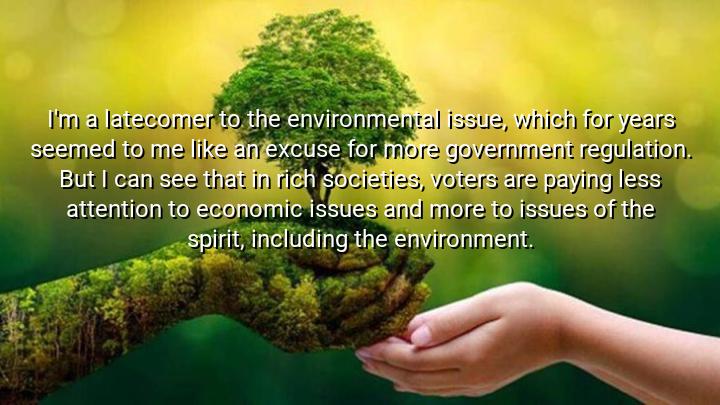




David Frum’s quote, “I’m a latecomer to the environmental issue, which for years seemed to me like an excuse for more government regulation,” reflects his initial skepticism about the growing focus on environmental concerns. Frum admits that, at first, he viewed the environmental movement as a means to justify increased government intervention in the economy, a perspective often shared by those who are wary of government overreach. His recognition of the environmental movement as potentially a cover for pushing regulatory agendas reflects a more conservative stance on government control.
However, Frum acknowledges a shift in his thinking when he observes that in wealthy societies, voters are increasingly prioritizing issues of the spirit, such as the environment, over economic issues. He notes that in affluent societies, where basic needs are often met, people are less focused on economic growth or material wealth and are more inclined to address quality of life concerns, including environmental sustainability. This shift reflects a broader societal trend where environmentalism becomes a major public concern, even in economically stable nations.
Frum’s comment reveals his evolving understanding of the environmental movement. Initially skeptical about its motivations, he now sees it as part of a broader cultural shift in wealthier nations, where people are becoming more conscious of the need to protect the planet for future generations. The quote reflects his recognition that environmental concerns are no longer just about government regulations but have become deeply embedded in the values and priorities of modern society.
In summary, Frum’s quote highlights his personal journey from viewing environmentalism as a political tool for expanding government regulation to understanding it as a central concern for affluent societies. As voters in wealthy nations increasingly focus on issues like sustainability and quality of life, the environment has become a significant cultural and political issue, reflecting a shift in societal values toward preservation and conservation.

AAdministratorAdministrator
Welcome, honored guests. Please leave a comment, we will respond soon