

If you take a look at history, you will find that the understanding of what is good and evil has always existed before the individual religions. The religions were only invented by people afterwards, in order to express this idea.
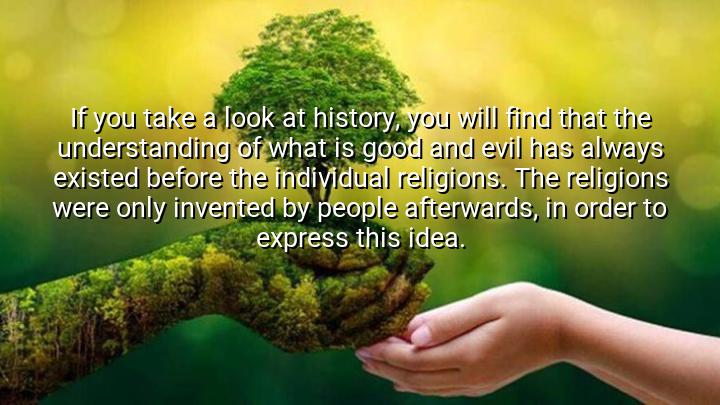




Salman Rushdie’s quote—“If you take a look at history, you will find that the understanding of what is good and evil has always existed before the individual religions. The religions were only invented by people afterwards, in order to express this idea”—argues that the concepts of good and evil are intrinsic to human nature and societal development, predating the formation of organized religions. Rushdie suggests that religions were created by humans as frameworks to articulate and formalize these moral concepts, rather than originating them. In essence, the understanding of right and wrong is something that emerged naturally within human societies, and religion simply provided a structure for expressing and codifying those ideas.
The origin of this perspective reflects Rushdie’s broader views on religion, morality, and human history, often explored in his writings. As a prominent author known for his critical stance on organized religion and his exploration of cultural and philosophical issues, Rushdie’s quote underscores his belief that moral questions are not confined to religious doctrine but are part of a larger, universal human experience. This view is consistent with his views expressed in works like The Satanic Verses, where he questions the role of religion in shaping identity and understanding.
By stating that religions were invented to express the pre-existing ideas of good and evil, Rushdie challenges the conventional notion that religion is the ultimate source of morality. Instead, he suggests that moral values existed independently of religion and were later organized into religious teachings as a means to structure social and ethical systems. This reflects a more humanistic view, where moral understanding is seen as a natural, cultural development rather than a divine revelation.
Ultimately, Rushdie’s quote invites reflection on the relationship between religion and morality, arguing that religions are one of many human attempts to explain and organize pre-existing moral principles. It encourages a broader understanding of good and evil as concepts that transcend religious boundaries, rooted in human experience and history rather than in any single religious tradition.

AAdministratorAdministrator
Welcome, honored guests. Please leave a comment, we will respond soon