

If you care about the environment, you want food and energy production to become more efficient and centralized. You want to put less inputs in and get more outputs out and get less waste.
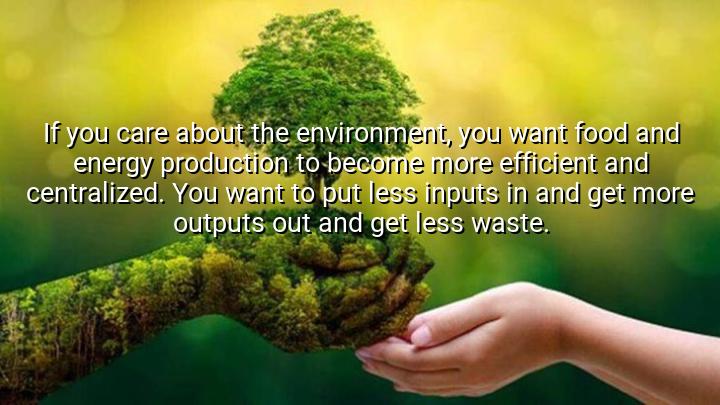




The quote by Michael Shellenberger — “If you care about the environment, you want food and energy production to become more efficient and centralized. You want to put less inputs in and get more outputs out and get less waste.” — emphasizes a pragmatic approach to environmental sustainability. Shellenberger argues that rather than relying solely on traditional or decentralized systems, we should embrace efficiency and centralization as tools to reduce resource consumption, increase output, and minimize waste. His focus is on improving the productivity of food and energy systems to meet human needs while minimizing environmental harm.
The origin of this quote is rooted in Shellenberger’s work as an environmental policy expert and energy advocate. Initially a supporter of progressive environmental movements, he later became known for challenging mainstream green ideologies, particularly those opposing nuclear energy or large-scale infrastructure. In his writings and public talks, especially in his book Apocalypse Never, Shellenberger argues for technological innovation, urbanization, and modern agriculture as essential pathways to an ecologically sound future.
By highlighting “more efficient and centralized” systems, Shellenberger contrasts his views with those who advocate for localized, organic, or low-tech solutions. He believes that centralized energy sources like nuclear power, and high-yield agriculture that uses fewer inputs (like land, water, and fertilizer), can reduce the overall environmental footprint. His vision focuses on scalability and resource optimization rather than ideological purity.
Ultimately, this quote reflects Shellenberger’s belief in rational environmentalism—one that prioritizes measurable outcomes and system-wide improvements. It challenges the assumption that “natural” or “small-scale” is inherently better, and instead promotes strategies that deliver the most benefit with the least ecological cost. His argument invites us to rethink how technological progress can be harnessed not against nature, but in service of a more sustainable planet.

AAdministratorAdministrator
Welcome, honored guests. Please leave a comment, we will respond soon