

Facts still matter, and social media is allowing for a wider range of new and independent voices to outcompete alarmist environmental journalism at legacy publications.
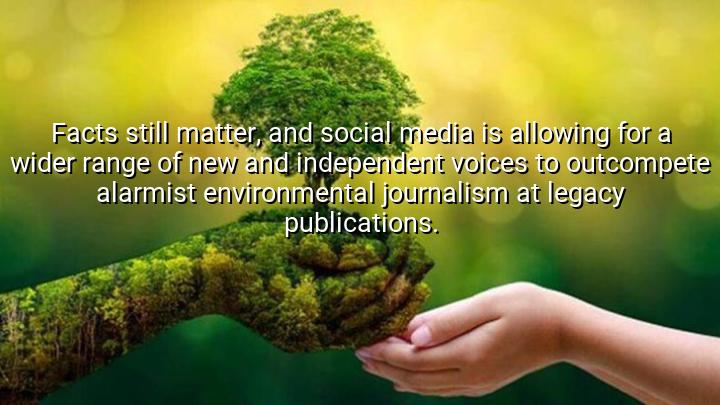




In this quote, Michael Shellenberger, an environmentalist and author, makes the case that facts continue to hold significant importance in discussions around environmental issues. Despite the growing influence of social media, Shellenberger emphasizes that credible, fact-based information should remain central to any meaningful dialogue on environmental topics. He highlights that social media platforms have opened up opportunities for new and independent voices to gain traction, potentially challenging more traditional, often alarmist, environmental narratives.
Shellenberger criticizes the tendency of some legacy publications to focus on alarmist reporting when it comes to environmental issues. He suggests that the sensational nature of these stories may not always reflect the full complexity or the facts of the situation. With the rise of social media, however, more diverse perspectives and alternative voices are emerging, offering a counterbalance to mainstream environmental journalism. These independent voices, often free from the editorial constraints of traditional outlets, can provide a broader and sometimes more balanced view of environmental concerns.
The quote speaks to a broader trend in how information is disseminated in the modern media landscape. With the proliferation of social media, there is a democratization of the narrative, where anyone with access to the platform can contribute to the conversation, sometimes leading to a more nuanced or divergent viewpoint than what may be presented in established media. Shellenberger’s reference to these independent voices suggests that alternative perspectives can thrive outside traditional media, potentially offering more thoughtful or grounded discussions on environmental issues.
Ultimately, Shellenberger is calling for a more fact-driven, less sensationalized approach to environmental reporting. By recognizing the power of social media to amplify new voices, he underscores the potential for these platforms to outcompete traditional outlets that may prioritize emotionally charged stories over accuracy. His statement reflects his belief in the value of informed discourse and the potential for social media to reshape the environmental conversation for the better.

AAdministratorAdministrator
Welcome, honored guests. Please leave a comment, we will respond soon