

If, then, knowledge be power, how much more power to we gain through the agency of faith, and what elevation must it give to human character.
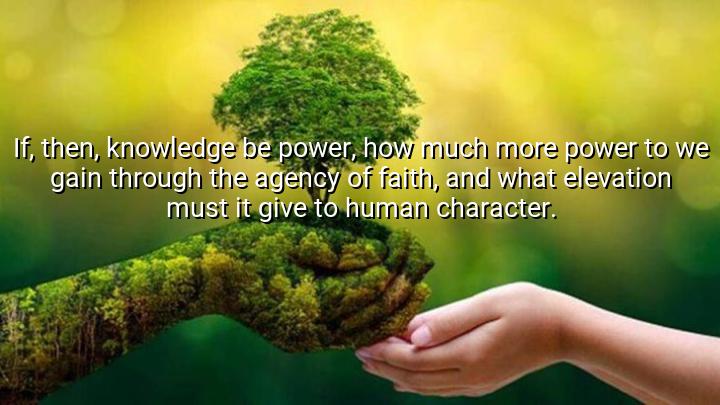




The quote “If, then, knowledge be power, how much more power do we gain through the agency of faith, and what elevation must it give to human character.” by Matthew Simpson reflects the relationship between knowledge, faith, and character. Simpson acknowledges the well-known idea that knowledge is power, meaning that learning and understanding give individuals the ability to influence the world. However, he argues that faith provides an even greater form of power—one that lifts the human character beyond mere intellect and into the realm of spiritual strength and moral purpose.
By highlighting the “agency of faith,” Simpson suggests that faith is not passive belief but an active force that empowers individuals to persevere, to act with conviction, and to inspire others. While knowledge equips us with tools, faith gives us courage and vision, allowing us to use knowledge for higher ends. In this way, faith becomes a source of elevation, shaping a person’s values, integrity, and capacity to live with meaning.
The origin of this thought lies in Simpson’s role as a 19th-century Methodist Episcopal bishop and influential preacher. Known as a close friend of President Abraham Lincoln, Simpson was a leading voice in American religious life during a time of great social and political upheaval. His sermons often emphasized the balance of education, faith, and moral character, seeing them as essential not only for personal growth but also for the moral health of the nation.
In essence, Simpson’s quote reminds us that while knowledge is essential, it is faith that gives it direction and higher purpose. The combination of the two produces true power, not just intellectual dominance but the elevation of character that allows people to live with dignity, conviction, and service to others. His words reflect a belief that education and faith together form the strongest foundation for human progress.

AAdministratorAdministrator
Welcome, honored guests. Please leave a comment, we will respond soon