

If the computer-guided robots turn out to be our superiors in every respect, then will they not find that they can run the world better without the need of us at all? Humanity itself will then have become obsolete.
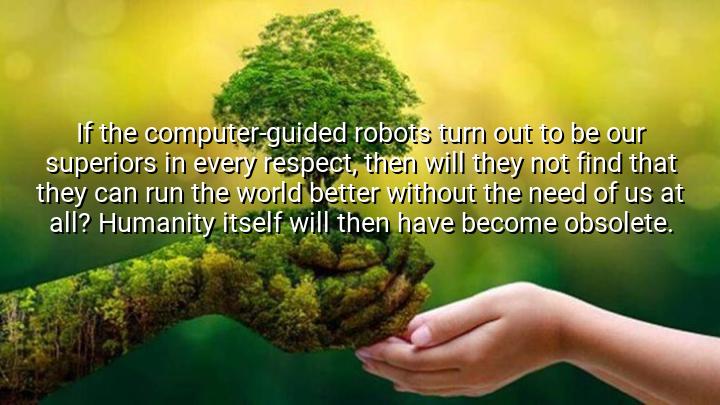




The quote by Roger Penrose, a renowned mathematician and physicist, explores the potential future impact of advanced technology and artificial intelligence on humanity. Penrose raises a provocative question about computer-guided robots surpassing humans in every respect, including intelligence, efficiency, and decision-making. The statement reflects a concern that as machines become more capable and autonomous, they may no longer require human input to manage or control the world.
At its core, the quote addresses the concept of obsolescence in the face of rapid technological advancement. Penrose suggests that if machines achieve superiority, human beings could lose their central role in society, potentially rendering human labor, judgment, and authority unnecessary. This evokes broader discussions about the ethical, social, and philosophical implications of creating entities that could outperform their creators.
The origin of the quote lies in Penrose’s work on consciousness, computation, and artificial intelligence, where he frequently examines the limits of human cognition compared to machines. His perspective is both cautionary and analytical, encouraging reflection on the trajectory of AI development and the responsibilities of those designing autonomous systems. Penrose’s words serve as a reminder that the rise of intelligent machines is not just a technical challenge but a societal one.
Ultimately, the quote underscores the need for thoughtful consideration of AI ethics, human relevance, and the balance between technological progress and human oversight. It highlights a fundamental question about the future: if machines can govern the world more efficiently than humans, what will be the role of humanity in shaping its own destiny? Penrose’s statement is a profound reflection on the potential consequences of unchecked technological superiority.
If you want, I can also make a shorter, 2-paragraph version with all the keywords bolded for quick reading.

AAdministratorAdministrator
Welcome, honored guests. Please leave a comment, we will respond soon