

If people destroy something replaceable made by mankind, they are called vandals; if they destroy something irreplaceable made by God, they are called developers.
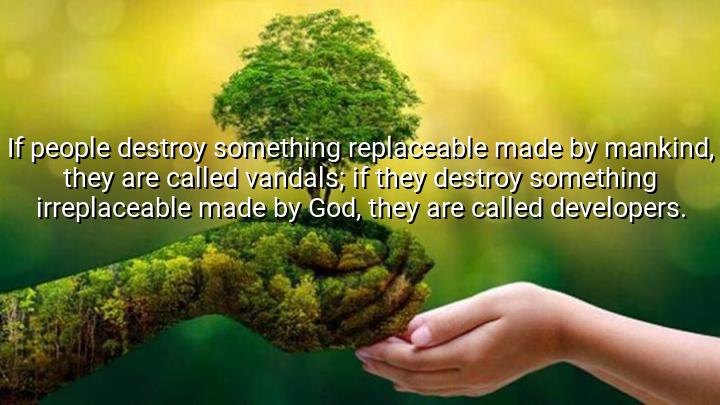




The quote, "If people destroy something replaceable made by mankind, they are called vandals; if they destroy something irreplaceable made by God, they are called developers," by Joseph Wood Krutch, critiques the priorities of modern society when it comes to development and conservation. Krutch, an American naturalist and author, uses this statement to highlight the irony in how society often treats the destruction of natural resources versus human-made creations. He contrasts the label of vandalism often applied to the destruction of human-made objects with the more acceptable destruction of nature in the name of progress.
The quote suggests that when people destroy artifacts or structures made by humans, they are seen as engaging in an immoral or destructive act. However, when the same kind of destruction is applied to something irreplaceable and natural, such as forests, wildlife, or landscapes, it is often justified as part of the process of development or economic growth. Krutch’s use of the word "developers" implies that the act of destruction is often sanctioned under the guise of progress, revealing the tension between economic interests and environmental preservation.
Krutch’s statement highlights the disconnect between the way society views the destruction of human-made objects versus natural ones, and questions the long-term consequences of this approach. His use of the word "developers" is especially pointed, as it refers to those who often destroy the natural world in the name of progress, construction, or real estate development, without fully considering the irreparable harm done to the environment. This contrast serves as a critique of the way development is often pursued without sufficient regard for the value of the natural world.
In essence, Krutch’s quote invites reflection on the moral values that guide human progress. It challenges us to reconsider what we deem valuable and to reassess the cost of development when it comes at the expense of something irreplaceable and invaluable, like the natural world. The quote underscores the need for a more balanced approach to development, where conservation and progress can coexist.

AAdministratorAdministrator
Welcome, honored guests. Please leave a comment, we will respond soon