

If people are good only because they fear punishment, and hope for reward, then we are a sorry lot indeed.
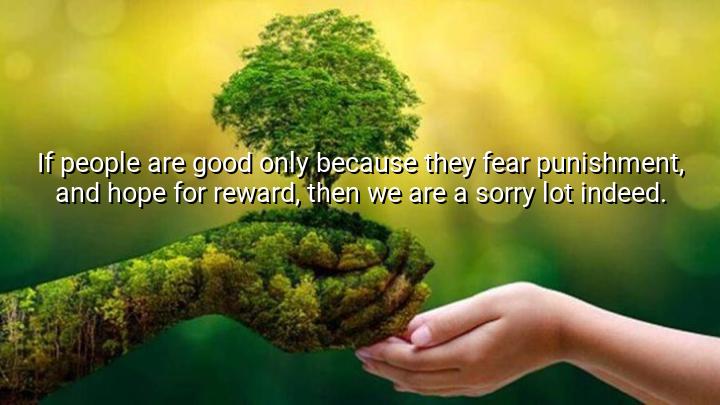




The quote "If people are good only because they fear punishment, and hope for reward, then we are a sorry lot indeed" is attributed to Albert Einstein, the renowned theoretical physicist whose influence extended beyond science into philosophy, ethics, and human values. Known not only for his groundbreaking work in relativity, Einstein also deeply reflected on the moral responsibilities of individuals and society. This quote captures his concern about the motives behind human behavior and the foundation of ethics.
Einstein suggests that if our goodness is driven solely by external incentives—like avoiding punishment or gaining rewards—then our morality is superficial and fragile. It implies that people are not truly ethical or compassionate, but merely behaving to protect or benefit themselves. In such a framework, integrity, empathy, and justice become transactional rather than intrinsic values. This, according to Einstein, would make us a “sorry lot,” meaning a morally impoverished and immature society.
The quote challenges the idea of conditional morality, which often underpins systems like authoritarian rule or rigid religious doctrines that focus on fear and obedience. Einstein believed that true ethical behavior arises from a deeper inner conscience, a sense of what is right that transcends reward or punishment. He advocated for autonomous morality—a kind of personal responsibility and compassion rooted in reason, empathy, and human dignity.
In essence, this quote calls for a higher standard of human behavior. It encourages individuals to cultivate virtues for their own sake, not because of consequences. Einstein’s reflection remains relevant in discussions of education, leadership, religion, and law, urging us to develop authentic morality that strengthens both individuals and the societies they build.

AAdministratorAdministrator
Welcome, honored guests. Please leave a comment, we will respond soon