

If it is the duty of the State to educate, it is the duty of the State also to bear the burden of education, namely, the taxation out of which education is provided.
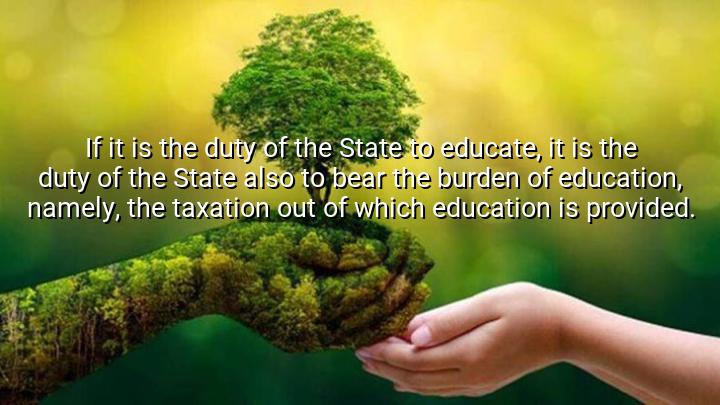




Edmund Barton’s quote emphasizes the responsibility of the State not only to provide education but also to bear the financial burden of it. He argues that since it is the duty of the government to ensure that citizens receive a proper education, it should also fund that education through taxation. In other words, Barton believes that the cost of education should not be left to individuals or private institutions but should be covered by the public purse, ensuring equal access for all.
Barton’s statement reflects the principle of public responsibility in providing essential services, such as education. By linking taxation to education, he suggests that it is a societal obligation, funded by the collective resources of the population. This ensures that everyone, regardless of their economic status, has access to the same opportunities for learning, and it also reinforces the idea that education is a public good that benefits society as a whole.
The origin of this quote comes from Barton’s role as Australia’s first Prime Minister, a period when he was instrumental in shaping the country’s policies on education and other social reforms. Barton believed in the importance of universal education, which would provide the foundation for a more equitable and prosperous society. This quote reflects his broader vision of a fairer system where the state plays an active role in providing essential services to its citizens.
In essence, Barton’s quote calls for a collective approach to education, where the financial burden is shared by society as a whole, rather than being shouldered by individuals alone. It advocates for a system where the state takes responsibility not just for creating the infrastructure of education but also for funding it, ensuring that all citizens have equal access to the tools they need for personal and societal advancement.

AAdministratorAdministrator
Welcome, honored guests. Please leave a comment, we will respond soon