

If death meant just leaving the stage long enough to change costume and come back as a new character, would you slow down? Or speed up?
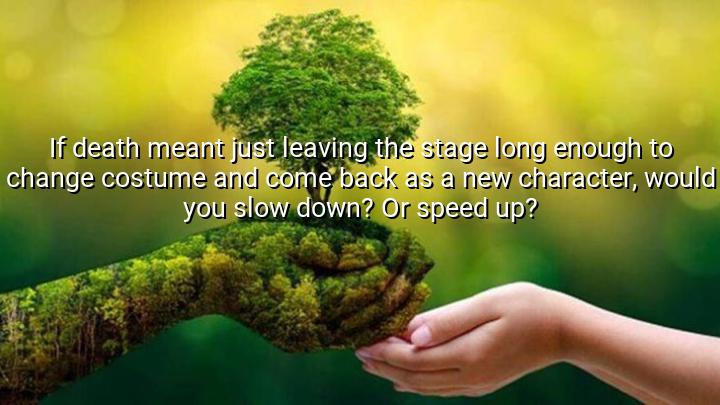




The quote "If death meant just leaving the stage long enough to change costume and come back as a new character, would you slow down? Or speed up?" by Chuck Palahniuk explores the idea of mortality and reincarnation through a metaphorical lens. By comparing life to a performance on stage, Palahniuk suggests that death might not be the end, but merely a temporary departure, like an actor leaving the stage to change into a different role. This idea raises the question of how we would live our lives if we knew that death was not final but just a brief interval before returning in a new form or identity.
The quote challenges our conventional views of death, asking us to consider whether we would live differently if we believed that death was merely a transitional phase rather than an irreversible conclusion. The hypothetical scenario of coming back as a new character implies that the opportunities for growth and transformation would be limitless, which may prompt someone to either take their time (slow down) to savor life or accelerate their actions, seizing the chance to explore new possibilities faster. The underlying question is whether death would make us fearful or empowered, depending on our understanding of what comes after.
Palahniuk, known for his dark, philosophical works such as Fight Club, often explores themes of identity, society, and the absurdity of life. This quote reflects his typical exploration of existential questions and the human condition. It taps into the universal fear and fascination with death while questioning whether our approach to life would change if we were not so bound by the finality of mortality.
Ultimately, Palahniuk's quote invites us to reflect on how our perceptions of death influence the way we live. If we viewed death not as an end but as a transformation, would we approach life with greater urgency or calm? It challenges us to think about how we might change our actions, values, and sense of purpose if we no longer saw death as something to fear but as part of an ongoing cycle of growth and reinvention.

AAdministratorAdministrator
Welcome, honored guests. Please leave a comment, we will respond soon