

If a man achieves victory over this body, who in the world can exercise power over him? He who rules himself rules over the whole world.
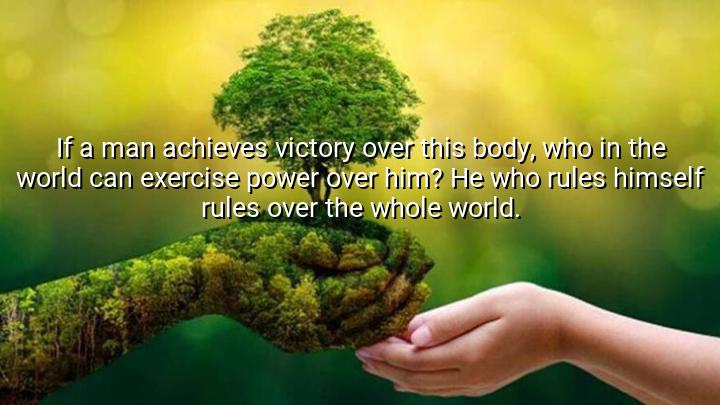




In this quote, Vinoba Bhave, a prominent Indian philosopher, spiritual leader, and disciple of Mahatma Gandhi, reflects on the power of self-mastery. When he says, "If a man achieves victory over this body, who in the world can exercise power over him?", he highlights the idea that true strength and independence come from within. Mastery over one's physical desires, impulses, and weaknesses leads to a state of inner freedom that makes external control nearly impossible.
Bhave follows with the profound statement, "He who rules himself rules over the whole world." This emphasizes that the most meaningful and enduring form of power is not dominion over others, but control over oneself. In this context, discipline, restraint, and spiritual focus are presented as tools for achieving not only personal liberation but also a kind of universal sovereignty. It suggests that self-governance is the highest form of leadership and wisdom.
This quote is deeply rooted in the philosophy of nonviolence and self-discipline, central to Bhave’s teachings and to the broader Gandhian tradition. His life's work, including the Bhoodan Movement, was built on the principles of moral strength, compassion, and inner transformation as means for social change. Through this lens, the quote encourages individuals to look inward, cultivate self-control, and live a life of purpose grounded in ethical and spiritual conviction.
The origin of this quote likely comes from Bhave’s speeches or writings, where he often spoke about the importance of self-rule (swaraj) not just as a political ideal but as a personal and spiritual goal. It reflects his belief that changing the world begins with changing oneself, and that true freedom arises when the body and mind are in harmony under conscious, disciplined will.

AAdministratorAdministrator
Welcome, honored guests. Please leave a comment, we will respond soon