

I would warn you that I do not attribute to nature either beauty or deformity, order or confusion. Only in relation to our imagination can things be called beautiful or ugly, well-ordered or confused.
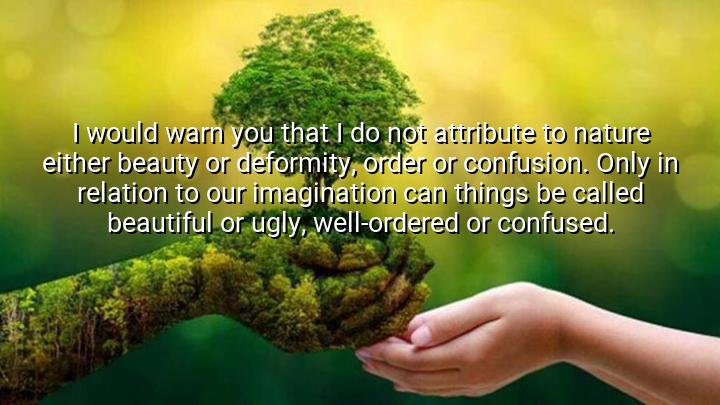




In this quote, Baruch Spinoza, a Dutch philosopher, challenges conventional ideas about nature and its inherent qualities, such as beauty, deformity, order, and confusion. Spinoza argues that these attributes do not exist in nature itself, but are instead projections of the human imagination. According to him, it is only in relation to our perception and interpretation of the natural world that things can be labeled as beautiful or ugly, well-ordered or confused. This suggests that our judgments about nature are subjective, influenced by our own thoughts and feelings rather than any objective reality inherent in the world around us.
Spinoza’s perspective reflects his broader philosophical views on perception and reality. He believed that humans often impose their own desires, emotions, and limitations onto the world, creating concepts of what is good or bad, harmonious or chaotic. For Spinoza, nature simply exists as it is, without any intrinsic moral or aesthetic value. The qualities we attribute to it, such as beauty or disorder, are a result of the way we interpret or relate to it.
This view aligns with Spinoza's pantheism, which posits that God and nature are one and the same. In his worldview, everything in nature is part of a larger, interconnected system, and our labeling of certain aspects of nature as beautiful or ugly reflects our human-centric understanding rather than an objective truth about the world itself. In essence, our perception shapes the way we experience the world, creating subjective meanings that may not exist in the external world.
Ultimately, Spinoza’s quote encourages a shift in how we think about nature and the values we attach to it. By acknowledging that our judgments of beauty, order, and confusion are shaped by our imagination, he invites us to reconsider the way we view the world around us, recognizing the role of our subjectivity in defining our experiences and perceptions. This understanding encourages a more open, non-judgmental approach to nature, seeing it as a neutral force rather than one shaped by human bias.

AAdministratorAdministrator
Welcome, honored guests. Please leave a comment, we will respond soon