

I was terribly shy when I was growing up, I really wasn't confident with other people and I think I was always afraid of up or not being this very cool, amazing person that I wanted to be.
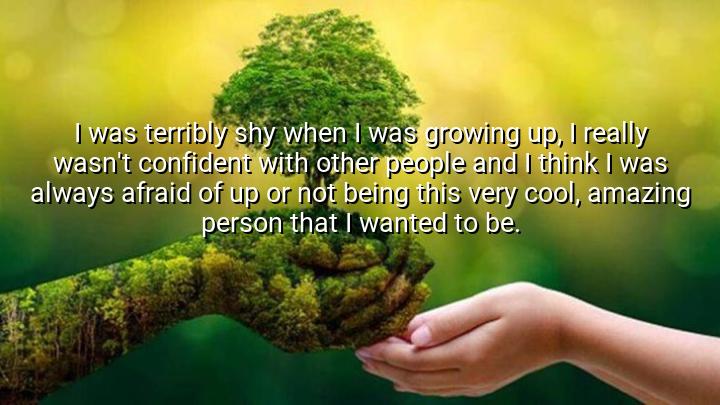




This quote by Emily Mortimer offers a heartfelt reflection on her personal struggles with shyness and self-confidence during her youth. Known for her roles in both British and American film and television, Mortimer openly admits that growing up, she didn’t feel comfortable around others and often doubted herself. Her vulnerability in this moment reveals a side of her that contrasts with the poised, charismatic characters she often portrays on screen.
The phrase “afraid of not being this very cool, amazing person that I wanted to be” highlights a common emotional challenge—striving to meet an idealized version of oneself. Mortimer is acknowledging the internal pressure many people feel to appear confident and appealing, even when they’re struggling inside. Her words resonate with anyone who has felt inadequate or anxious about not measuring up to social expectations.
The origin of this quote likely comes from an interview or profile where Mortimer was discussing her early life or her path to becoming an actress. In sharing this, she sheds light on the human side of fame—reminding audiences that behind the polished performances are real people who have battled insecurities like everyone else.
Ultimately, Mortimer’s quote is a quiet but powerful message about self-acceptance and growth. It shows that even those who seem effortlessly talented often start with fear and doubt, but through experience and courage, they evolve into the confident individuals they once only dreamed of becoming.

CACao A
What strikes me here is the emotional honesty—Emily isn't just reflecting on shyness, but on the idealized version of herself she felt she couldn't live up to. It raises an important question: do we create false ideals that we’re doomed to fall short of? And if so, how do we learn to be at peace with who we are, instead of who we think we should be?
VBnguyen v b
This really hit home for me. It makes me wonder how much of our adult personality is shaped by trying to compensate for what we lacked growing up. Did Emily pursue acting partly as a way to explore and overcome her shyness? There’s something poetic about using performance to connect with others when you once feared social interaction. I’d love to hear her thoughts on that transformation.
VLPhuong Vu Lan
I appreciate how candid she is here—it takes courage to admit to that kind of vulnerability. But I’m also curious: does the entertainment industry reward authenticity like this, or does it still favor those who project constant confidence? Has Emily’s openness about her struggles made her more approachable in professional circles, or has it ever been perceived as a weakness? That balance must be difficult to navigate.
PNPhung Ngoc
Reading this brings back memories of my own social insecurities growing up. I wonder—does anyone ever truly outgrow that fear of not measuring up? Even when someone appears successful on the outside, do those early feelings of inadequacy still linger deep down? I'd love to hear more about how Emily manages those old insecurities today, especially in such a public and high-pressure industry.
TThyh
This quote makes me think about the role self-perception plays during adolescence. Did Emily feel external pressure to be ‘cool,’ or was it mostly internalized expectations? It’s amazing how often we build up these ideal versions of ourselves and then measure every move against them. I’d be curious to know what specific experiences helped her shift from self-doubt to self-assurance—was it a person, a career break, or something else?