

I want to collect more records from terrorists, but less records from innocent Americans. The Fourth Amendment was what we fought the Revolution over! John Adams said it was the spark that led to our war for independence, and I'm proud of standing for the Bill of Rights, and I will continue to stand for the Bill of Rights.
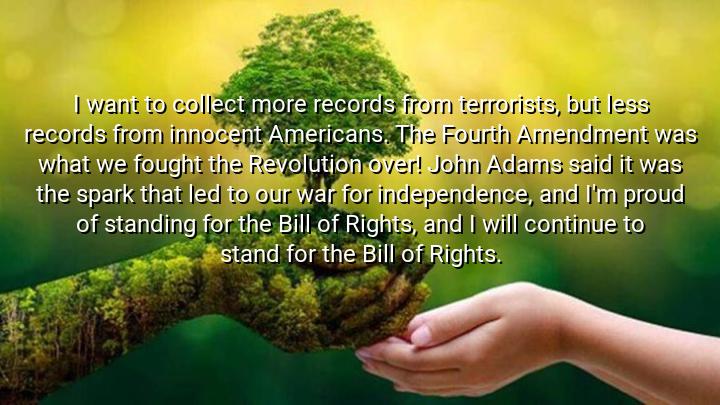




In this quote, Rand Paul emphasizes his commitment to protecting the Fourth Amendment, which guards against unreasonable searches and seizures. He contrasts his desire to focus on collecting records related to terrorists while minimizing the collection of data from innocent Americans. Paul's reference to the Fourth Amendment highlights his belief in the importance of protecting individual privacy and civil liberties even in the fight against terrorism. He argues that the foundational principles of the Bill of Rights must not be sacrificed for security measures.
Paul references John Adams and his view that the Fourth Amendment was a central issue in the lead-up to the American Revolution, suggesting that the protection of individual rights and freedom was the very spark that ignited the conflict for independence. By invoking Adams, Paul stresses that standing for the Bill of Rights is not only a matter of law but a defense of the core ideals on which the nation was founded. His words suggest that compromising these principles, particularly in the context of surveillance and privacy, goes against the very essence of the American Revolution.
The origin of this quote comes from Rand Paul, a U.S. Senator from Kentucky known for his libertarian views and strong advocacy for civil liberties. Throughout his career, Paul has been a vocal critic of government overreach, particularly when it comes to issues like privacy, surveillance, and constitutional rights. His stance on the Fourth Amendment reflects his broader commitment to protecting individual freedoms from government intrusion.
In this context, Paul's words underscore his belief that security should not come at the cost of personal freedoms and that the Bill of Rights—especially the Fourth Amendment—must be defended in the face of growing surveillance powers. He frames his position as one that honors the revolutionary spirit of the American Revolution, aiming to uphold the principles of freedom and privacy that were fought for in the nation's fight for independence.

AAdministratorAdministrator
Welcome, honored guests. Please leave a comment, we will respond soon