

I used to think religion was just more of the same thing. Dump responsibility on the big guy. Now I see an importance in that. It's a relief to accept that not everything is under your control.
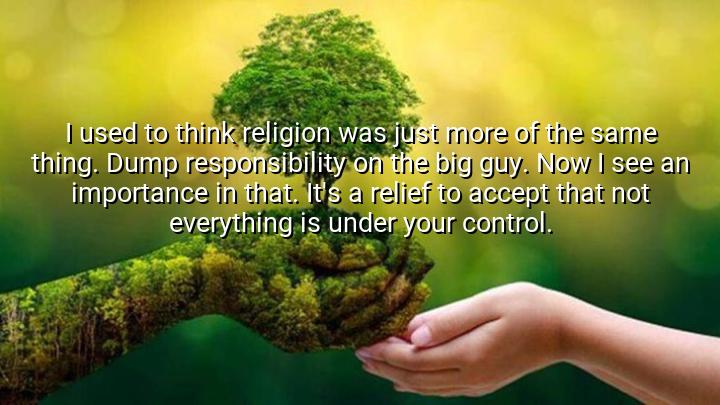




In this quote, Barbara Kingsolver, an acclaimed author known for her works on themes of nature, community, and personal responsibility, reflects on her evolving perspective on religion. Initially, she viewed religion as a way to avoid responsibility, seeing it as an easy escape where individuals could dump their problems onto a higher power. However, Kingsolver has come to see the importance of this aspect of religion, particularly in the sense that it offers comfort and relief from the overwhelming pressure of having to control every aspect of life.
Kingsolver's shift in perspective underscores a common existential struggle—the desire to control life’s outcomes versus the reality that much of life is beyond individual control. By embracing the idea that not everything is under one’s control, she acknowledges that faith can provide a sense of peace. It allows people to relinquish some of their anxieties and accept that some things are beyond human ability to change or influence. This can be a profound relief, offering a form of mental and emotional release from the burden of trying to manage everything on one's own.
The statement also speaks to a deeper spiritual understanding, where religion provides a framework for recognizing the limits of human power. By letting go of the need to control everything, one can find greater freedom in surrendering to a higher power or simply in acknowledging that life will unfold in ways that are not entirely predictable or controllable. Kingsolver’s comment speaks to the comfort that comes with humility and the acceptance of human limitations, which are often central themes in many spiritual and philosophical traditions.
Ultimately, Kingsolver’s quote is a reflection on how religion, despite its flaws or misunderstandings, can provide a valuable psychological and spiritual tool for dealing with life's uncertainties. By accepting that not everything is within our control, we can achieve a more balanced and peaceful approach to life. It encourages a mindset of acceptance and trust, reminding us that sometimes surrendering control is not a sign of weakness but a path to inner peace and freedom.

AAdministratorAdministrator
Welcome, honored guests. Please leave a comment, we will respond soon