

I think you can be depressed and flourish, I think you can have cancer and flourish, I think you can be divorced and flourish. When we believed that happiness was only smiling and good mood, that wasn't very good for people like me, people in the lower half of positive affectivity.
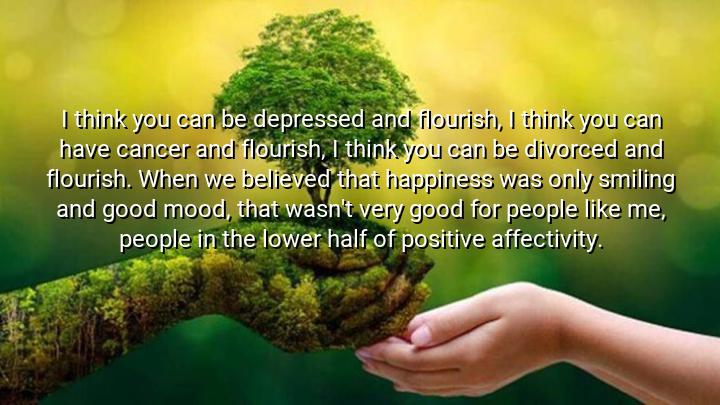




The quote by Martin Seligman — "I think you can be depressed and flourish, I think you can have cancer and flourish, I think you can be divorced and flourish. When we believed that happiness was only smiling and good mood, that wasn't very good for people like me, people in the lower half of positive affectivity" — challenges the traditional notion of happiness as simply being about positive emotions or a cheerful disposition. Seligman, a prominent psychologist and one of the founders of positive psychology, suggests that flourishing — which is a deeper, more holistic form of well-being — is possible even in the face of adversity, such as depression, cancer, or divorce.
Seligman is advocating for a broader understanding of happiness that goes beyond just good mood or surface-level emotions. His view emphasizes the importance of flourishing, which involves not just feeling happy in the moment, but having a sense of meaning, purpose, and personal growth, even during difficult times. He argues that those with low positive affectivity — people who naturally tend to feel less upbeat or are more prone to negative emotions — can still live fulfilling lives and achieve a sense of well-being despite challenges.
The quote also points to the inadequacy of defining happiness purely in terms of smiling or maintaining a positive emotional state. By acknowledging that adversity, such as mental health struggles or serious illness, does not preclude flourishing, Seligman broadens the scope of what it means to live a good life. This aligns with his work in positive psychology, which seeks to understand the full spectrum of human emotions and well-being, and promotes a more inclusive and realistic understanding of how people can thrive in all circumstances.
In essence, Seligman’s quote suggests that true happiness or flourishing isn’t about always being in a good mood but about resilience, meaning, and the ability to thrive despite life’s hardships. It encourages a shift in perspective, especially for those who may not experience intense positive emotions, to recognize that they too can live fulfilling lives by finding purpose and growth through their experiences.

AAdministratorAdministrator
Welcome, honored guests. Please leave a comment, we will respond soon