

I think that music, being an expression of the human heart, or of the human being itself, does express just what is happening - the whole of human experience at the particular time that it is being expressed.
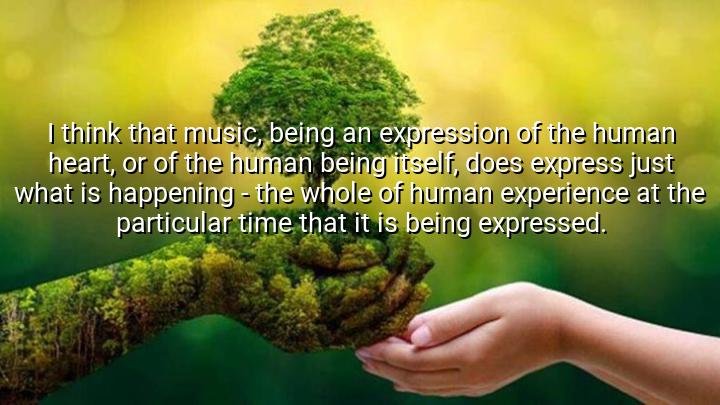




The quote by John Coltrane—“I think that music, being an expression of the human heart, or of the human being itself, does express just what is happening—the whole of human experience at the particular time that it is being expressed”—reveals his deep belief in music as a mirror of the soul and a reflection of the moment. For Coltrane, music is not just entertainment or art, but a living, breathing extension of our emotions, struggles, and truths. It communicates what words often cannot.
Coltrane, one of the most influential jazz saxophonists in history, was known for his spiritual and philosophical approach to music. Emerging during a time of social upheaval and transformation in the United States, his work captured the emotional weight and spiritual searching of the era. This quote likely stems from his personal journey—one that fused musical innovation with a pursuit of universal meaning. His compositions often transcended traditional jazz structures to reflect the complexity of the human condition.
By referring to music as the expression of the human heart, Coltrane emphasizes its power to convey authentic emotion and inner truth. The mention of “the whole of human experience” shows that he viewed music as all-encompassing—capable of representing joy, sorrow, anger, peace, and everything in between. To him, each note played in the present moment captures a snapshot of existence, making music a kind of temporal testimony.
Ultimately, Coltrane’s quote is a testament to the transformative power of music. It expresses his belief that musical expression is not limited by genre or technique, but is instead a spiritual force that connects us to our deeper selves and to each other. In every improvisation and composition, Coltrane saw a chance to articulate the unspoken truth of being human in a given moment.

AAdministratorAdministrator
Welcome, honored guests. Please leave a comment, we will respond soon