

I think that every child grows up with the ideas that what we are given, is our society. Your education, and your mother and father, they tell you this is how it is, but then you hit adolescence and you think, 'Is it? Why? Why is it like that?' Sometimes that questioning leads to something more.
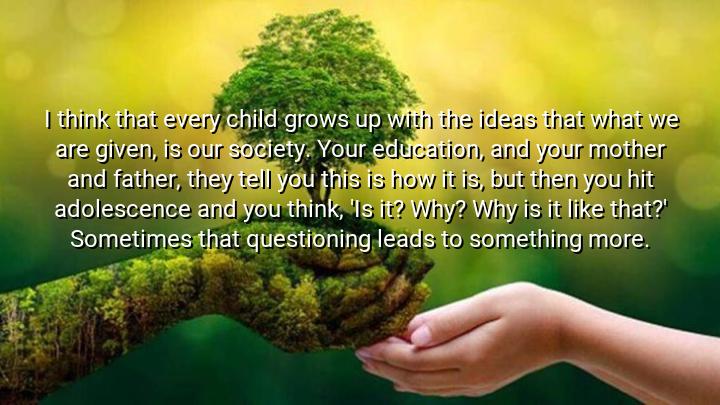




The quote “I think that every child grows up with the ideas that what we are given, is our society. Your education, and your mother and father, they tell you this is how it is, but then you hit adolescence and you think, 'Is it? Why? Why is it like that?' Sometimes that questioning leads to something more.” by Alice Englert reflects on the natural process of questioning and self-discovery during adolescence. As children, we accept what our parents, education, and immediate environment teach us as unquestionable truths. However, as we grow older, particularly in adolescence, we begin to challenge these assumptions and ask deeper questions about society and our place within it.
By stressing the shift from acceptance to questioning, Englert points to a crucial stage in personal development. This adolescent questioning is not mere rebellion but an essential step toward critical thinking and independence. Asking “Why is it like that?” opens the door to new perspectives, encouraging individuals to seek deeper meaning and sometimes even pursue paths that diverge from what they were taught.
The origin of this reflection lies in Englert’s background as an actress, writer, and director who grew up in a creative family—her mother being filmmaker Jane Campion. Her exposure to both artistic and intellectual environments likely shaped her awareness of how education and family shape identity, but also how the act of questioning can inspire creativity and growth. Her insight mirrors broader philosophical and psychological views that true maturity comes when individuals begin to think for themselves.
In essence, Englert’s quote highlights the tension between social conditioning and personal awakening. Childhood provides structure and identity, but it is through questioning and sometimes rejecting what we are taught that we discover who we truly are. For some, this process leads to profound transformation—“something more”—that shapes not only their individual lives but potentially contributes to reshaping society itself.

AAdministratorAdministrator
Welcome, honored guests. Please leave a comment, we will respond soon