

I think it makes people in the Pentagon kind of nervous to know that chemical agents and environmental factors could cause so much damage in terms of what may happen in the future.
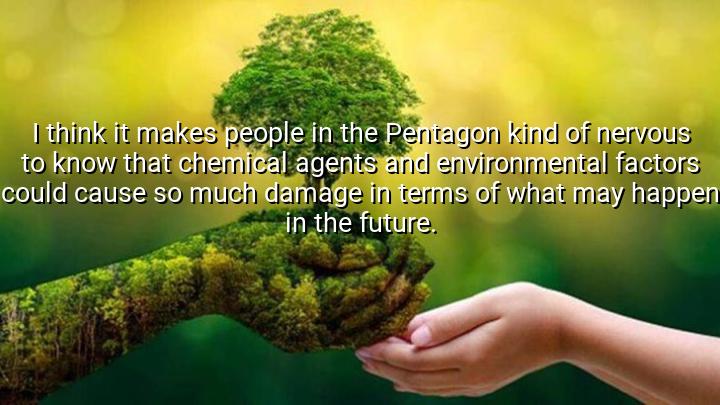




Bernie Sanders’ quote reflects his concern about the potential long-term damage caused by chemical agents and environmental factors, particularly in the context of national security. He suggests that these elements—often overlooked in traditional defense discussions—could have significant implications for the future. Sanders points out that the Pentagon, as the center of U.S. defense policy and planning, may be uneasy or nervous about the reality that environmental threats and toxic substances could undermine both public health and military readiness.
The quote underscores Sanders’ broader view that environmental issues, such as pollution, climate change, and the use of hazardous chemicals, are not only ecological concerns but also national security issues. Chemical agents, whether from warfare or industrial activities, can have long-lasting effects on human health and the environment. Similarly, the destabilizing impact of environmental degradation—such as the displacement of communities due to climate change—can create global instability that could complicate military and strategic operations.
Sanders’ remarks highlight the urgency of addressing environmental and chemical hazards, not just from an ecological perspective, but from a security standpoint. By drawing attention to the Pentagon’s possible anxiety, he implies that environmental risks are becoming increasingly difficult to ignore, as their effects are felt on both a global and local scale. The quote also signals Sanders’ long-standing advocacy for environmental policy that prioritizes both ecological sustainability and human well-being.
Ultimately, Sanders’ statement urges policymakers to view environmental protection and chemical safety as integral to national defense, suggesting that neglecting these issues could leave the country vulnerable to unforeseen threats. His approach advocates for a more holistic understanding of security, one that includes both traditional defense and proactive efforts to mitigate the harmful impact of human activities on the environment.

AAdministratorAdministrator
Welcome, honored guests. Please leave a comment, we will respond soon