

I think everyone should go to college and get a degree and then spend six months as a bartender and six months as a cabdriver. Then they would really be educated.
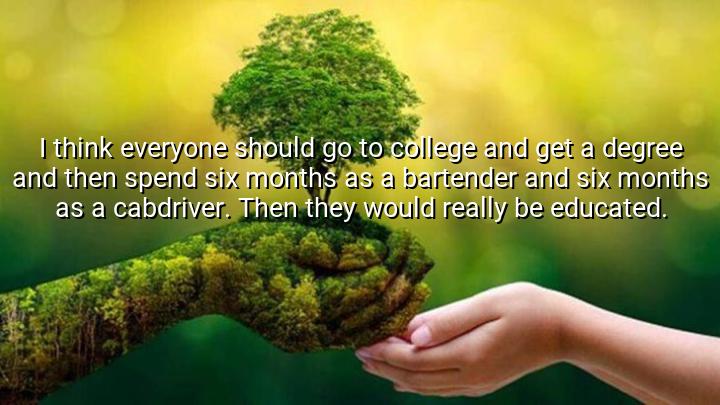




In the quote "I think everyone should go to college and get a degree and then spend six months as a bartender and six months as a cabdriver. Then they would really be educated," Al McGuire offers a unique perspective on education. McGuire suggests that while academic credentials like a college degree are important, they only represent one aspect of education. He advocates for a more holistic approach to learning, where hands-on, real-world experiences—such as working as a bartender or cabdriver—are just as valuable as formal education in shaping a person’s character, practical skills, and understanding of life.
McGuire’s quote underscores the idea that true education goes beyond classroom knowledge. By spending time in roles that require direct interaction with diverse people and dealing with unpredictable situations, individuals can learn important life lessons in communication, problem-solving, and empathy. These real-world experiences, McGuire argues, offer valuable insights into the human condition and give individuals a deeper appreciation for the challenges people face, making them more well-rounded and socially aware.
The suggestion to work as a bartender or a cabdriver speaks to McGuire’s belief in practical learning. These professions are not typically associated with high social status, but they provide an opportunity for personal growth and developing life skills that formal education might not teach. Through these roles, individuals learn about people, how to manage stressful situations, and how to relate to others from various walks of life—skills that are often undervalued in traditional academic settings.
Ultimately, McGuire’s quote advocates for a balance between theoretical education and real-life experience. He suggests that to be truly educated, individuals need to understand not just academic concepts but also the everyday realities of life. His perspective encourages a more pragmatic view of education, one that values both intellectual achievement and the wisdom gained through direct, lived experience.

AAdministratorAdministrator
Welcome, honored guests. Please leave a comment, we will respond soon