

I refuse to accept the view that mankind is so tragically bound to the starless midnight of racism and war that the bright daybreak of peace and brotherhood can never become a reality... I believe that unarmed truth and unconditional love will have the final word.
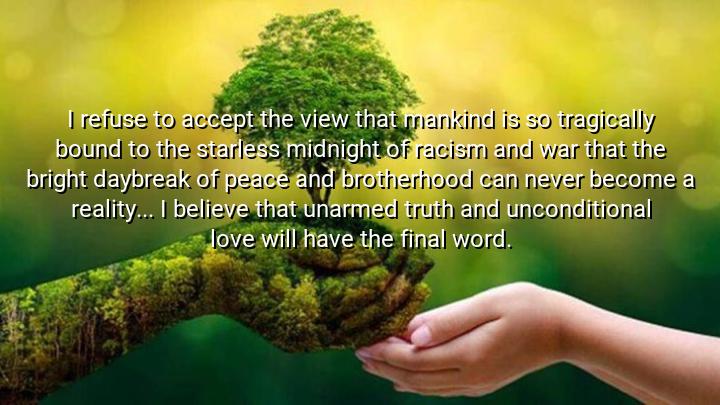




In this powerful statement, Martin Luther King Jr. rejects the notion that humanity is forever trapped in the darkness of racism and war, which he metaphorically describes as the "starless midnight." He insists that it is possible for the world to experience the bright daybreak of peace and brotherhood—a future where unity, equality, and compassion replace division and conflict. This reflects his unwavering belief in hope and progress, even in the face of overwhelming adversity, advocating for the transformative potential of love and truth in overcoming societal injustices.
King’s mention of unarmed truth and unconditional love is significant because it highlights his philosophy of nonviolent resistance. For King, true social change does not come through force or violence, but through the power of truth and love, which are disarmed and accessible to all. This contrasts with the brutal realities of racism and war, which rely on division, hatred, and violence. By asserting that these nonviolent forces will "have the final word," King expresses his belief that moral righteousness will eventually triumph over the forces of oppression and conflict, even if it takes time.
The phrase “the final word” emphasizes King’s deep faith in justice and his belief that ultimately, human goodness and the pursuit of peace will prevail. This speaks to his broader philosophy, which was rooted in Christian teachings and civil rights activism, where he consistently advocated for love, forgiveness, and reconciliation as tools for achieving lasting social transformation. King's optimism was grounded in his vision of a world where people, regardless of their race or background, could live together in harmony.
The origin of this quote comes from one of King’s famous speeches, where he expressed his enduring hope for a better future. Known for his leadership in the Civil Rights Movement and his advocacy for nonviolent protest, King was committed to overcoming the systemic racism and violence that plagued America in the 20th century. His message of peace and brotherhood continues to inspire generations, as it calls for both individual and collective action toward a more just and compassionate world.

AAdministratorAdministrator
Welcome, honored guests. Please leave a comment, we will respond soon