

I love you when you bow in your mosque, kneel in your temple, pray in your church. For you and I are sons of one religion, and it is the spirit.
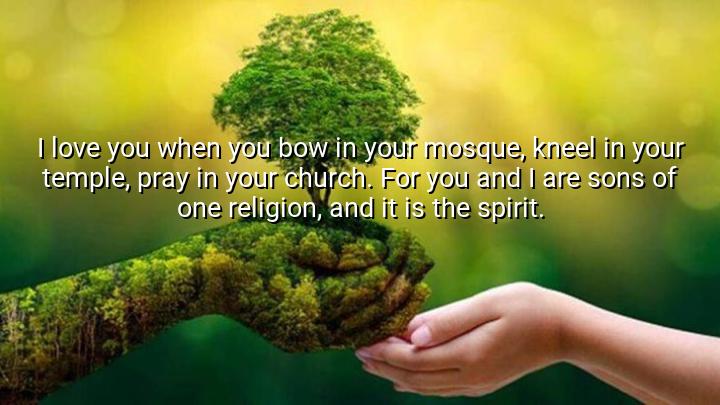




Khalil Gibran’s quote, “I love you when you bow in your mosque, kneel in your temple, pray in your church. For you and I are sons of one religion, and it is the spirit,” speaks to the universal nature of love and spirituality. Gibran, a Lebanese-American poet and philosopher, was deeply influenced by both Eastern and Western philosophies, and his work often explored the connections between humanity and the divine. Here, he emphasizes that the true essence of religion transcends the boundaries of specific practices or rituals, pointing instead to a common spiritual truth shared by all people, regardless of the outward form of worship.
In this quote, Gibran expresses that love and spirituality are not confined to a particular place of worship or a specific religious tradition. Whether one is bowing in a mosque, kneeling in a temple, or praying in a church, the underlying essence of their spiritual connection is the same. The spirit, as Gibran describes it, is the universal force that unites all people, beyond religious affiliations or doctrinal differences. This idea reflects Gibran's belief in the importance of inner spirituality rather than external religious rituals.
The concept of spirit being the unifying force also reflects Gibran’s humanistic view that all people are connected through their shared experiences of love, compassion, and the pursuit of truth. By acknowledging the diversity of religious practices, Gibran emphasizes that the essence of true religion is not in the specific rituals one follows but in the deeper connection to the spiritual world and to each other as human beings.
Ultimately, Gibran’s quote encourages tolerance and unity among people of different faiths, inviting them to recognize their common bond in the pursuit of the spirit. His words suggest that true love transcends religious divisions, and that what truly matters is the shared human experience of seeking a connection to something greater than oneself. Through this lens, religion becomes not an outward expression of difference, but a shared journey of the spirit.

AAdministratorAdministrator
Welcome, honored guests. Please leave a comment, we will respond soon