

I long for the time when all human history is taught as one history, because it really is.
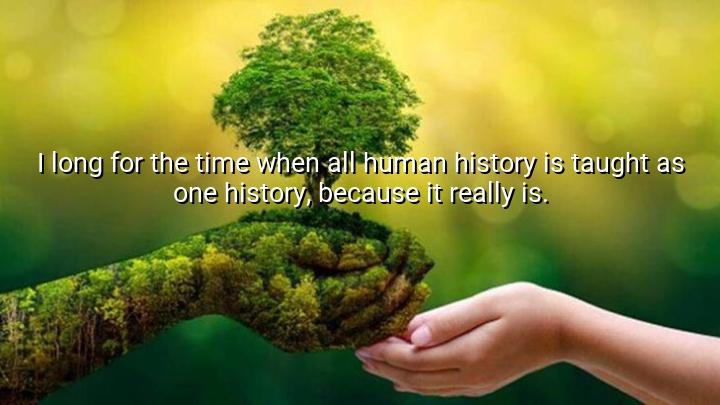




The quote by Maya Angelou—“I long for the time when all human history is taught as one history, because it really is.”—expresses her vision of unity and shared humanity. Angelou emphasizes that while history is often divided by race, nationality, or culture, in truth it forms a single interconnected story of human experience. By calling for history to be taught as “one history,” she underscores the need to recognize the common threads that bind humanity rather than perpetuating divisions.
The meaning of the quote lies in its challenge to the fragmented way history is often presented. In many educational systems, history is compartmentalized—Western history, African history, Asian history—each taught as though separate from the other. Angelou argues that this approach obscures the reality that civilizations, ideas, and struggles have always influenced one another. By uniting these narratives, history can be understood not as isolated stories but as a collective human journey of triumphs, failures, and progress.
The origin of this perspective can be found in Angelou’s lifelong advocacy for education, human rights, and cultural inclusivity. As a poet, performer, and activist, she used her voice to highlight the shared dignity of all people. This quote reflects her broader philosophy that literature, art, and history should build bridges, not barriers. Her own works, such as I Know Why the Caged Bird Sings, were deeply rooted in the African American experience but spoke to universal themes of struggle, identity, and resilience—embodying her belief in the interconnectedness of human stories.
In a broader sense, Angelou’s words remain a call to reimagine education. By framing history as “one history,” she envisions a world where the contributions and struggles of all peoples are acknowledged as part of a shared legacy, fostering empathy and reducing prejudice. Her statement is both a critique of how history has been taught and a hopeful vision of how it might be taught in the future: not as a set of divided narratives, but as a unified account of the human condition.
Would you like me to also connect this idea to how modern approaches to global history and world studies are beginning to reflect Angelou’s vision?

AAdministratorAdministrator
Welcome, honored guests. Please leave a comment, we will respond soon