

I had seen birth and death but had thought they were different.
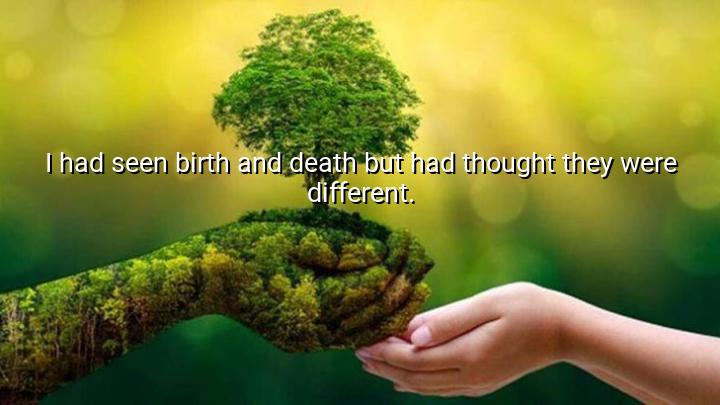




In this quote, T. S. Eliot, a prominent poet and playwright, reflects on the profound interconnectedness of birth and death. He acknowledges that while he had witnessed both events, he had previously thought of them as separate, distinct moments in life. The quote suggests a deeper realization that, despite being viewed as opposites, birth and death are fundamentally part of the same cycle of existence, with one inevitably leading to the other.
Eliot's words highlight the complex relationship between the beginning and end of life. By recognizing that these two events are not truly separate, he points to the idea of continuity and transformation within life itself. This realization may speak to the ephemeral nature of human existence, where every beginning carries the seeds of an eventual end, and every death makes room for new life.
The quote reflects Eliot's philosophical exploration of life, time, and existence, themes that are central to much of his work. In his writings, especially in works like The Waste Land, Eliot frequently explores the cyclical nature of life and the tension between creation and destruction. Here, he offers a moment of personal insight, suggesting that the separation between life and death is an illusion we hold until we are confronted with the deeper truths of existence.
Ultimately, Eliot’s quote encourages us to reconsider the boundaries we place between key aspects of the human experience, such as birth and death. It challenges us to think about life not as a linear progression but as a cycle where the end of one phase inevitably leads to the beginning of another, encouraging a more holistic view of existence and time.

AAdministratorAdministrator
Welcome, honored guests. Please leave a comment, we will respond soon