

I find the parallels between how some investors refuse to recognise the trends and our reaction to some of our environmental challenges very powerful. There is an unwillingness to process unpleasant data.
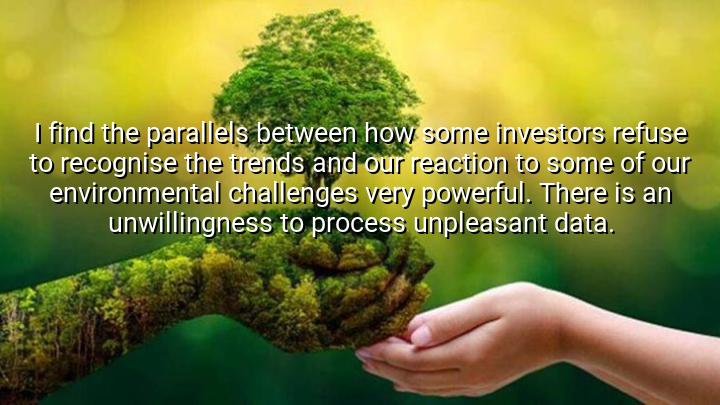




The quote by Jeremy Grantham, “I find the parallels between how some investors refuse to recognise the trends and our reaction to some of our environmental challenges very powerful. There is an unwillingness to process unpleasant data,” draws a comparison between financial behavior and environmental awareness. Grantham, a British-born investor and co-founder of Grantham, Mayo, & Van Otterloo (GMO), suggests that just as some investors ignore market signals, society often ignores pressing environmental data, particularly when it points to climate change, resource depletion, or ecological decline.
The meaning of the quote emphasizes human cognitive biases, especially the tendency to avoid confronting uncomfortable truths. Grantham implies that ignoring evidence—whether in investments or environmental science—can lead to delayed action, amplified risks, and serious consequences. The quote underscores the need for rational decision-making and proactive responses based on objective data rather than wishful thinking or denial.
The origin of the quote comes from Grantham’s work in finance and environmental advocacy, where he has often linked economic systems with sustainability issues. Known for his focus on long-term trends in markets and climate, Grantham frequently highlights how short-term thinking and denial can exacerbate both financial and ecological crises, advocating for data-driven approaches to mitigate risks.
Overall, the quote serves as a warning about the dangers of ignoring critical information. Grantham emphasizes that both investors and society at large must confront unpleasant realities, whether economic or environmental, to make informed decisions and avoid catastrophic outcomes. It underscores the importance of acknowledging trends and acting proactively rather than delaying response due to discomfort or denial.

AAdministratorAdministrator
Welcome, honored guests. Please leave a comment, we will respond soon