

I don't generally talk about medical terms when I discuss my position as a disabled person. I take a social rather than medical approach to disability, and so long Latin names for congenital conditions are not relevant.
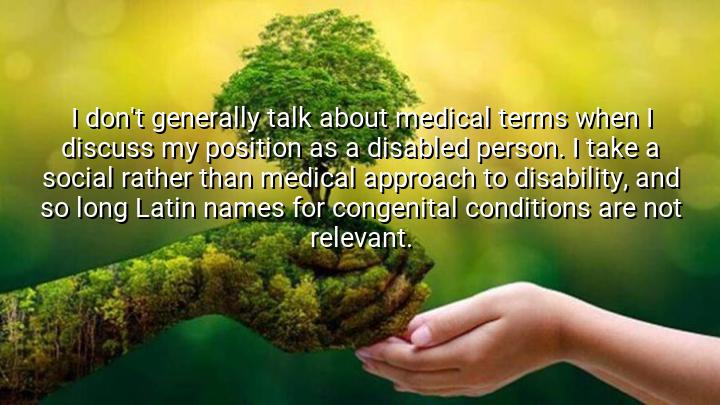




The quote by Stella Young, “I don't generally talk about medical terms when I discuss my position as a disabled person. I take a social rather than medical approach to disability, and so long Latin names for congenital conditions are not relevant,” emphasizes the distinction between the medical and social models of disability. Young highlights that her focus is on societal attitudes, barriers, and inclusion, rather than the clinical specifics of her condition. The quote underscores the importance of shifting the conversation from diagnosis to social context and equity for people with disabilities.
The origin of the quote comes from Young’s work as a disability advocate, comedian, and journalist. Known for her incisive commentary on ableism and social perceptions of disability, Young often emphasized the need to reframe disability as a social issue rather than a purely medical one. By rejecting the relevance of long Latin medical terms, she stresses that the focus should be on how society accommodates and respects people with disabilities.
This statement also challenges the tendency to define disabled people by their medical conditions rather than their lived experiences. Young advocates for understanding disability through the lens of access, inclusion, and rights, suggesting that labeling and terminology can distract from addressing real-world barriers and fostering equality. Her approach reframes disability as a social responsibility rather than a personal medical problem.
Ultimately, the quote reflects Young’s commitment to social advocacy and redefining perceptions of disability. It encourages readers to prioritize inclusion, respect, and accessibility over technical medical jargon, demonstrating that meaningful dialogue about disability is rooted in social awareness and the removal of systemic barriers rather than detailed medical classifications.

AAdministratorAdministrator
Welcome, honored guests. Please leave a comment, we will respond soon