

I do not bring forgiveness with me, nor forgetfulness. The only ones who can forgive are dead; the living have no right to forget.
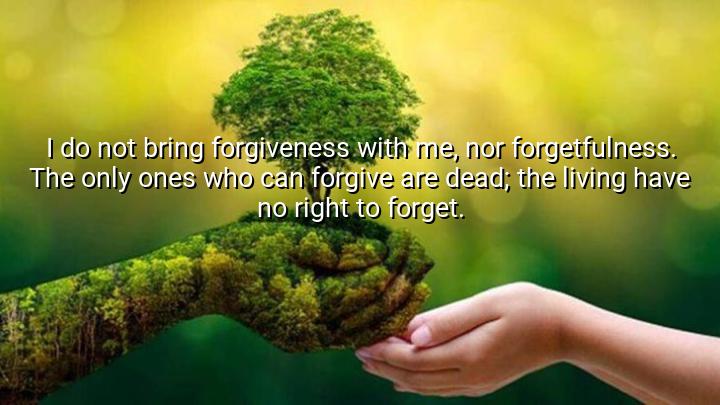




In this quote, Chaim Herzog reflects on the complex nature of forgiveness and forgetfulness in the face of deep wounds or historical wrongs. Herzog suggests that he does not personally bring forgiveness or forgetfulness with him, indicating that he does not believe in the simplistic notion of letting go of past hurts or injustices without full understanding or reconciliation. He makes the powerful assertion that forgiveness is a matter for those who have passed, implying that the dead, who no longer suffer from the consequences of past actions, may have the perspective to forgive. The living, however, are bound by the realities of their experiences and the impact of the wrongs they have endured.
Herzog’s perspective suggests that forgetting is not an option for those who are still alive to experience the consequences of injustice. Unlike forgiveness, which can be a personal choice or an act of grace, forgetting is seen as a kind of denial that erases the painful lessons of history. By saying that "the living have no right to forget," Herzog emphasizes the importance of memory and the need to confront the past in order to understand and learn from it. Forgetting, in his view, can lead to repeating the same mistakes.
The quote also speaks to the idea that forgiveness is a deeply complex, often communal or historical process. Herzog may be hinting at the challenges of forgiving injustices that are deeply ingrained, such as those involving national or cultural trauma. His remark suggests that forgiveness must come on its own terms, and it can’t be rushed or demanded, especially when those involved are still living with the repercussions of past actions.
Ultimately, Herzog's statement invites reflection on how memory, justice, and forgiveness interact. While he does not advocate for forgetting or immediate forgiveness, he underscores the ethical and emotional complexity of moving past profound wrongs. By saying the living cannot forget, Herzog emphasizes the necessity of remembering history and acknowledging its impact in shaping both individual and collective identities.

AAdministratorAdministrator
Welcome, honored guests. Please leave a comment, we will respond soon