

I count religion but a childish toy, and hold there is no sin but ignorance.
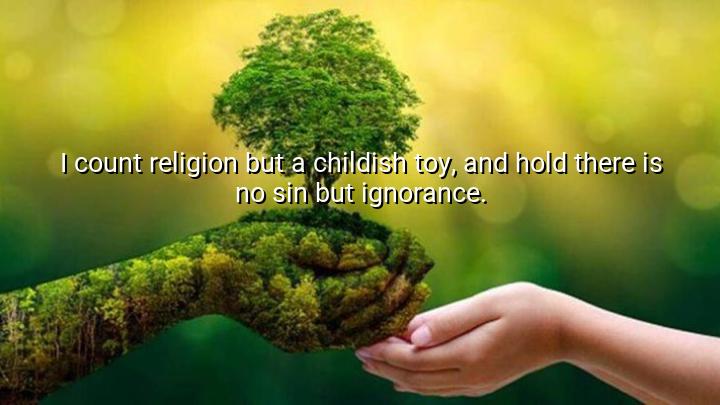




In this quote, Christopher Marlowe expresses a sharp critique of religion and its role in human life. By referring to religion as a "childish toy", Marlowe implies that it is something immature, perhaps naive or unnecessary for those who seek deeper, more rational truths. The phrase suggests that religion, with its rituals and doctrines, may be a crutch for those who haven't yet matured into a more enlightened understanding of the world. This reflects a skepticism toward religious systems that he perceives as mere superstition or tradition without substantial basis in reality.
The second part of the quote, "there is no sin but ignorance," further builds on Marlowe's rationalist and humanist beliefs. To him, ignorance—the lack of knowledge or understanding—constitutes the only true moral failing. This challenges traditional religious notions of sin, suggesting that wrongdoing is not inherently tied to violating divine commandments, but rather to being uninformed or unwise. By emphasizing ignorance as the root cause of human error, Marlowe advocates for intellectual growth, education, and the pursuit of truth as the means to overcome moral failings.
Marlowe’s worldview, as expressed in this quote, reveals his rejection of conventional religious authority and his belief in the importance of human reason and understanding. His writing often questioned traditional societal structures, and this sentiment echoes the larger Renaissance movement, which celebrated the exploration of knowledge, science, and individuality. For Marlowe, true morality is tied to the pursuit of wisdom, not blind adherence to dogma.
The origin of this quote lies in Marlowe's broader works and his personal philosophy, often evident in his plays like Doctor Faustus. Known for his daring and controversial views, Marlowe was ahead of his time in challenging the religious and political norms of his day. His bold approach to questioning religious and moral systems reflects the Renaissance spirit of intellectual rebellion and exploration, where faith was often questioned in favor of a more human-centered perspective.

AAdministratorAdministrator
Welcome, honored guests. Please leave a comment, we will respond soon