

I care not much for a man's religion whose dog and cat are not the better for it.
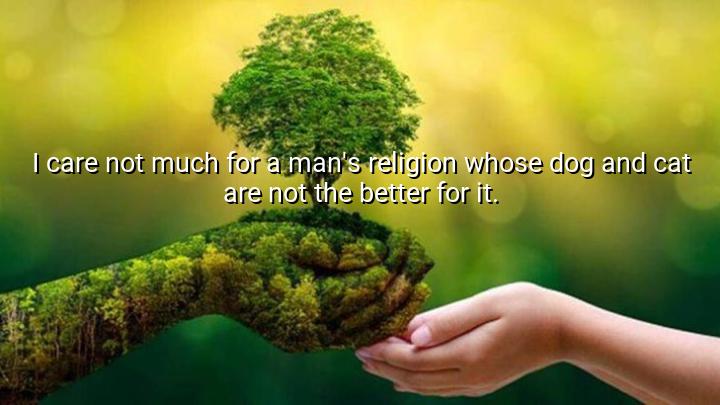




In this quote, Abraham Lincoln critiques a person’s religion by emphasizing its practical implications, suggesting that the true measure of one’s faith is how it affects their actions toward others, including animals. Lincoln asserts that a man who professes to follow a religious belief but does not demonstrate kindness and compassion toward creatures like his dog or cat is not living according to the principles of true religion. This reflects a broader moral view that religious beliefs should manifest in positive, humane actions in everyday life, extending beyond abstract teachings to tangible, real-world effects.
Lincoln’s quote also touches on the idea that religion should foster virtue and kindness, not only toward fellow human beings but also toward all forms of life. His emphasis on how a person treats their pets serves as a metaphor for how their belief system should influence their broader behavior. In Lincoln’s view, true faith is not simply about outward piety or ritual but should be measured by one’s compassion and care for the creatures in their care, suggesting that morality is an integral part of faith.
By invoking the example of a dog and cat, Lincoln also implies that faith should inspire a sense of responsibility and gentleness, qualities that should manifest in everyday life, no matter how small or seemingly insignificant the action. This serves as a reminder that religion should shape how individuals behave in their most personal and practical relationships, not just in public or ceremonial contexts.
The origin of this quote comes from Abraham Lincoln, the 16th president of the United States, known for his strong moral convictions, commitment to justice, and profound sense of empathy. While Lincoln was not outspoken about his personal religious views, his actions and statements often reflected a belief in a benevolent and compassionate moral code. This quote exemplifies his belief that religion should translate into action and kindness in everyday life, regardless of one’s social or religious status.

AAdministratorAdministrator
Welcome, honored guests. Please leave a comment, we will respond soon