

I can get very philosophical and ask the questions Keats was asking as a young guy. What are we here for? What's a soul? What's it all about? What is thinking about, imagination?
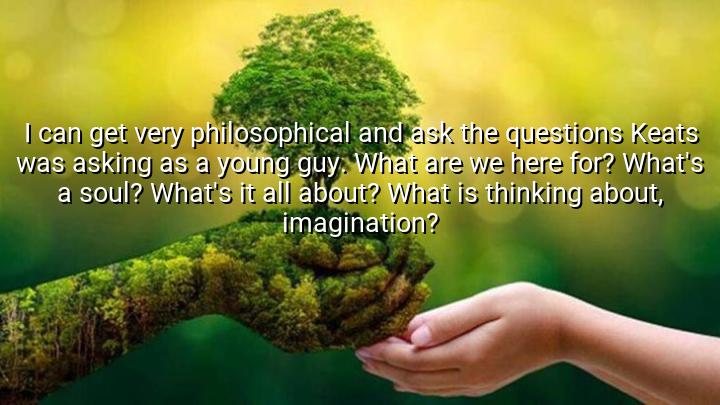




The quote "I can get very philosophical and ask the questions Keats was asking as a young guy. What are we here for? What's a soul? What's it all about? What is thinking about, imagination?" by Jane Campion reflects her tendency to delve into deep, existential inquiries about life and the human experience. By invoking the English poet John Keats, Campion draws a parallel between her own intellectual curiosities and the profound questions Keats posed in his youth, especially around themes of existence and the nature of the self.
The reference to Keats suggests that Campion, like the poet, grapples with the meaning of life and the role of the individual in a larger, often mysterious universe. Keats famously explored these themes in his poetry, questioning the purpose of life, the nature of soul, and the function of imagination. Campion, an acclaimed filmmaker, acknowledges these questions as a foundation for her own creative process, suggesting that art and life are interconnected in their search for meaning.
By questioning what thinking and imagination are about, Campion highlights her exploration of how the mind works and how creativity can illuminate or give meaning to our existence. In asking these existential questions, she echoes the philosophical musings that have shaped human thought for centuries, blending them with her own artistic vision. Ultimately, this quote illustrates Campion's belief in the power of philosophy and art to probe the most profound aspects of human life and the universe.
In this sense, the quote reflects Campion's introspective approach to her filmmaking, where her works often explore themes of identity, desire, and the complexity of human emotion. Her reference to Keats suggests that she, too, is engaged in a search for answers—using the lens of her imagination and philosophical inquiry to navigate the mysteries of life.

AAdministratorAdministrator
Welcome, honored guests. Please leave a comment, we will respond soon