

I believe in the separation of church and state, but I do not believe in the separation of politics from religion.
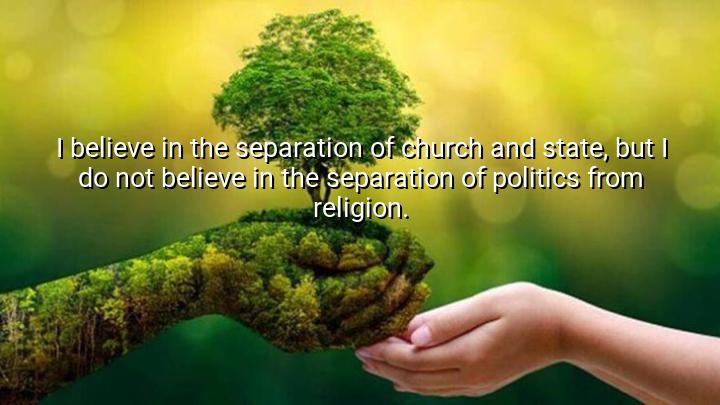




The quote by Rick Warren, “I believe in the separation of church and state, but I do not believe in the separation of politics from religion,” highlights the distinction between government institutions and personal faith, while acknowledging that religious values can influence political decision-making. Warren emphasizes that while the state should remain neutral in religious matters, politicians and citizens inevitably bring their moral and ethical beliefs—often shaped by religion—into the political sphere. It reflects the balance between institutional neutrality and individual conscience.
The origin of this quote comes from Rick Warren, a prominent evangelical pastor and author of The Purpose Driven Life, who has frequently addressed the role of faith in public life. Warren advocates for the integration of ethical and moral principles, often derived from religious teachings, in shaping policy and leadership, while maintaining that government should not favor or enforce any particular religion. The quote mirrors his perspective on faith-informed civic responsibility.
At its core, the quote underscores the interconnection between values and governance. By distinguishing between church-state separation and religion-informed politics, Warren conveys that faith can guide moral reasoning, policy priorities, and leadership decisions, without compromising the neutrality of government institutions. It highlights the idea that religion shapes character, which in turn shapes political actions.
Ultimately, Rick Warren’s statement serves as a reflection on the role of religious conviction in public life. It encourages citizens and leaders to allow faith and ethics to inform their political choices while respecting the principle that the state must remain neutral, ensuring a balance between personal beliefs and institutional fairness in a pluralistic society.

AAdministratorAdministrator
Welcome, honored guests. Please leave a comment, we will respond soon